
"My nanny slanders me every day and speaks ill of me." Actress Ye Xuan, choking up during a livestream, recounted the inheritance dispute she encountered while her father was seriously ill. This real-life "nanny rises to the top" saga not only tears open the scars of family ties and interests, but also reflects the increasingly acute dilemma of "inheritance by non-relatives" in an aging society. As a lawyer who has handled over a hundred family disputes, I want to say: this is by no means an isolated case, but a potential crisis for countless families.
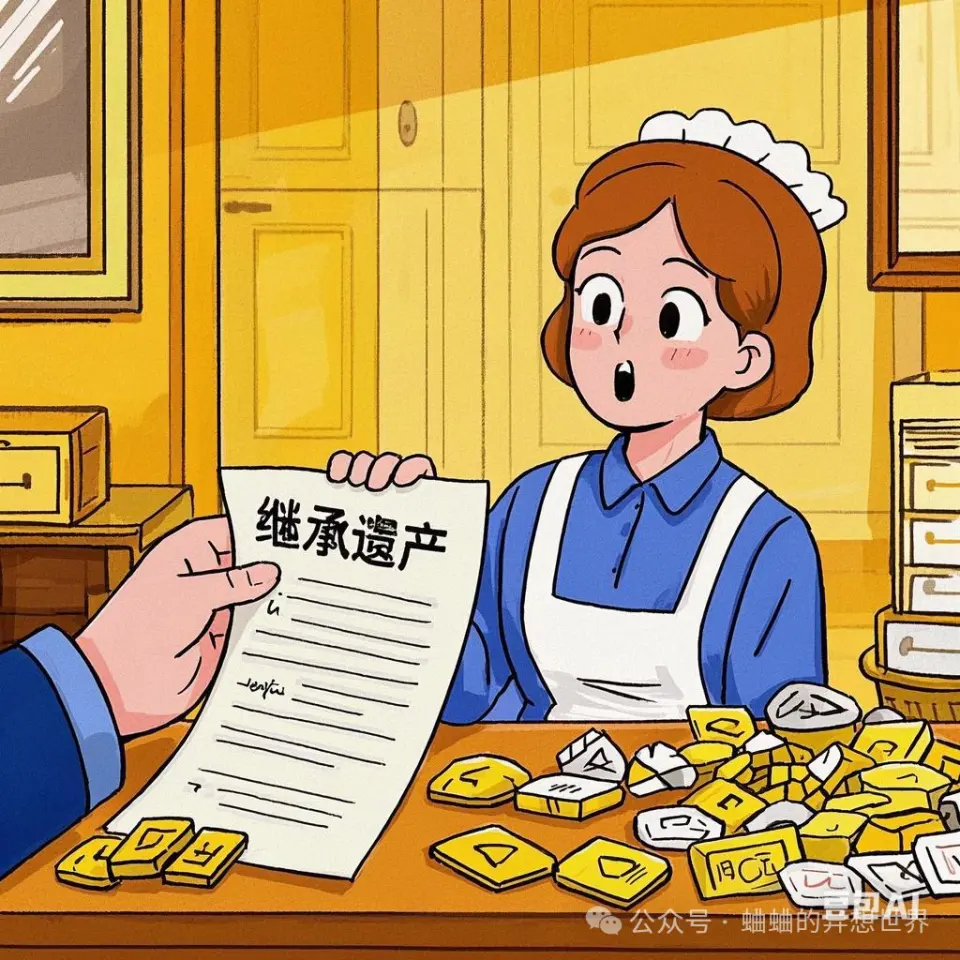
In many people's understanding, parents' property will naturally be inherited by their children. But reality is cruel: incidents of nannies becoming "lawful heirs" occur frequently. What hidden logic lies behind this? Today, let us explore this in depth and teach you how to protect your parents' hard-earned money.
Testamentary succession and testamentary gift: a one-character difference, a world of difference
Many children do not realize the intricacies until they face the nanny in court. When an elderly person gives property to a nanny, it is usually not testamentary succession but a testamentary gift. Under Article 1133 of the Civil Code, heirs by testamentary succession must be persons within the statutory scope, such as a spouse, children, or parents. If an elderly person makes a will giving property to a nanny, strictly speaking this constitutes a testamentary gift.
A testamentary gift is subject to a time limit: the nanny must expressly accept it within 60 days of learning of the gift, failing which it is deemed waived. In reality, however, some nannies plan ahead and even induce the elderly person to execute a notarized testamentary gift agreement to circumvent the time limit. In one Shanghai case, an elderly person made a testamentary gift of real property to a nanny, and because the children failed to produce evidence of the nanny's "coercion" within 60 days, they ultimately lost real property worth tens of millions.
How do courts rule? Three ironclad rules in nanny inheritance cases
Through analysis of more than 200 cases in recent years, we found that the logic by which courts uphold a nanny's inheritance mainly includes the following points:
Case 1: The Hangzhou professor's real property worth tens of millions case (2021)
Professor Wang, an 82-year-old widower living alone, had children long settled abroad. Nanny Zhang cared for him for seven years, responsible not only for daily living but also accompanying him to medical visits on multiple occasions. In 2020, Wang, by notarized will, left real property worth 12 million yuan to Zhang, leaving only 100 thousand yuan to each of his children.
The court held that the notarized will was valid in form and that the notary had verified Wang was lucid when signing; the children's claims that Zhang induced the elderly person to take medication and that Wang had Alzheimer's disease lacked sufficient evidence and could not overturn the will's validity. Ultimately, the court dismissed the children's claims, the real property went to Zhang, and the children were required to vacate the property within 10 days.
Case 2: The Shanghai octogenarian couple's "dual wills" case (2022)
There was an octogenarian couple in Shanghai whom the nanny cared for over a long period, and the two sides formed a de facto support relationship. The nanny submitted 367 group photos and 52 videos of grocery shopping to prove that she was as close to the elderly as family.
The court, applying the "appropriate distribution" provision of Article 1131 of the Civil Code, ruled that the savings belonged to the caregiver, and that the children were allocated only the old furniture with a market value of 300 thousand. The judge was explicit: the law looks only at whether the chain of evidence is complete, and does not consider the depth of family affection.
Case 3: The Case of an Octogenarian Couple in Shanghai Bequeathing to a Neighbor (2024)
Old Mr. Yu's son, Xiaoxin, failed to fulfill his duty of support, so Old Mr. Yu revoked the 3300 thousand yuan he had previously gifted to him, and through a will distributed his estate to his neighbor Mr. He and his daughter Xiaofei. Mr. He had long cared for Old Mr. Yu and his disabled daughter, and had also advanced medical expenses.
The court held that Xiaoxin's failure to perform his duty of support fell within the circumstance under Article 663 of the Civil Code that "where the donee fails to perform an obligation, the gift may be revoked"; and that Mr. He had actually performed the duty of support, and the testamentary gift to him was consistent with public order and good morals. The final judgment revoked part of the gift to Xiaoxin, with Mr. He receiving 297 thousand yuan and the remainder going to Xiaofei.
Case 4: The Case of an Elderly Person in Beijing Gifting to a Good Friend by a Holographic Will (2024)
Old Mr. Wang, an elderly person living alone, was cared for by his good friend Mr. Mei's family for more than 20 years, and before his death he made a holographic will gifting all his property to Mr. Mei. Old Mr. Wang's statutory heirs, his remarried wife Old Mrs. Cheng and his daughter Xiaojing, asserted that the will was invalid.
The court held that the holographic will met the formal requirements of the Civil Code, namely that it was written in the testator's own hand, signed, and complete as to date; and that Mr. Mei had actually performed the obligation of "support during life and burial after death," so the contents of the will were true and valid. The final judgment ordered Old Mrs. Cheng and Xiaojing to pay 670 thousand yuan of the estate to Mr. Mei.
Case 5: The Case of a Grandson Inheriting Real Property by a Will Written on the Testator's Behalf (2025)
The Shen Weipeng couple, by a will written on their behalf, bequeathed real property to their grandson Shen Jie. Some of the children questioned the authenticity of the will, claiming that the person who wrote it on the testator's behalf did not appear in court, and that Liu Fang only affixed a fingerprint and did not sign.
The court held that the will written on the testator's behalf had two witnesses present throughout and was lawful in form; that Shen Jie had demonstrated acceptance of the testamentary gift through acts such as actually occupying the house and renovating it, and that the 60-day period had not been exceeded; but that the will had not reserved a "forced share" for the disabled son Shen Chao, so it was partially invalid and the shares needed to be adjusted. The final judgment awarded Shen Jie 90% of the real property and Shen Chao 10%.
Summary of the Core Reasoning of the Courts' Judgments
\1. The formal validity of a will takes priority: the courts will strictly examine the form of the will, such as notarized, written on the testator's behalf, or holographic wills, and once there is a formal defect, the will is directly invalid.
\2. Substantive fairness and performance of obligations: if the legatee (such as a caregiver or neighbor) has actually performed support obligations, the validity of the will is more likely to be upheld; conversely, if the children have failed to fulfill their duty of support, their right of inheritance may be revoked.
\3. Rigid application of the forced heirship system: even if the will is valid, a necessary share must be reserved for heirs who lack the capacity to work; otherwise, part of the will's contents is invalid. The caregiver's success often hinges on long-term care records and a flawless notarization procedure, while the common reason for the children's loss is their inability to prove the will invalid or to prove that they fulfilled their support obligations.
The psychology of the elderly: why trust a caregiver rather than one's own children?
From a psychological perspective, there are mainly the following three mechanisms:
\1. Stockholm-like dependence: research by the American Society on Aging shows that if an elderly person living alone spends more than 6 months in daily contact with a caregiver, pathological emotional dependence may develop. Just as a kidnap victim depends on the kidnapper, the elderly person will actively find reasons for the caregiver's demands.
\2. Hospice-compensation psychology: "The one who wiped my body at the end was her, not you!" This is an actual record from a court hearing at the Beijing Fengtai Court. Psychology confirms that persons in the dying stage develop infant-like attachment to those who accompany them, which forms a mirror reflection of the dependence children had on their parents in childhood.
\3. Reverse Oedipus complex: some elderly persons subconsciously project the caregiver as an "idealized child" and complete psychological compensation through material gifts. Data from a certain will bank shows that elderly persons who call their caregiver "daughter/son" have a 4 times higher probability of making a testamentary gift.
Practical guide for lawyers: this is more useful than installing surveillance cameras to guard against caregivers
As a lawyer who has handled 137 cases, I have summarized the following 4 measures that caregivers fear most:
\1. "Support-trace archiving technique": make audio recordings of at least 2 visits per month, for example recording the elderly person saying "my daughter came last weekend"; note "father's convalescence expenses" in WeChat transfer remarks to prove the fact of support; keep all medication expense receipts, and originals are essential because copies are invalid.
\2. "Estate isolation safe": place real estate, deposits and other assets into a family trust in advance, agreeing that "the caregiver may receive compensation of at most 3 times the salary." A wealthy businessman in Guangzhou used this measure to successfully reduce the caregiver's acquisition from 3 million to 180 thousand.
\3. "Fighting poison with poison notarization technique": take the elderly person to complete two notarizations. One is a "Mental Condition Assessment Report," proving that the elderly person has testamentary capacity; the other is a "Dynamic Record of Testamentary Intent," providing that the children must be present each time the will is amended.
\4. "Toolkit for countering with evidence": if you discover any unusual conduct by the caregiver, immediately obtain the residential compound surveillance footage and preserve everyday clips such as pushing the wheelchair or taking out the trash; apply for preservation of bank statements to check whether there have been any large-value transfers; and lawfully place a voice recorder in the caregiver's room to gather evidence.
The Final Trial: How Many Points Are You Worth in Your Parents' Hearts?
Once, on a night of torrential rain, a son who had lost his case broke down crying at the law firm: "I bought him imported medicine costing 8,000 yuan, yet I lost out to a bowl of plain congee from the caregiver." I asked him: "You ordered the medicine online and had it shipped home; she fed him the congee one spoonful at a time after blowing it cool. Tell me, was the elderly man really buying medicine, or buying the hope of staying alive?"
What those elderly people wrote down in their wills was never merely the distribution of property: in the interlayer of the will in the Hangzhou case was hidden the caregiver's handwritten "7-year daily care record"; at the very bottom of the safe deposit box of the Shanghai couple lay a faded childhood family photo of their children; and in Beijing, an elderly person said to a lawyer shortly before death: "If I give the money to outsiders, the children will come every day to file complaints, and that way they will be able to talk with me more..."
In a true inheritance war, what is fought over is never money, but those moments of warmth that you could have held onto yet let slip. After reading this article, if you still think "my parents have no money anyway," then you may already have lost.
Right now, please open your parents' WeChat and pin their chat window to the top; take a screenshot of this article and send it to the family group chat, @everyone; click follow and reply "anti-caregiver" to obtain the "Inheritance Protection Battle Kit" (including recording scripts/evidence-gathering guide/will template). Finally, ask yourself: do you have a photo of yourself with your parents on your phone that was taken within the past week?

