
Recently, Hong Kong Legislative Council member Kenneth Fok's "property map" left netizens stunned—among his 35 properties, 7 are for personal use and the remaining 28 are rented out; the relevant properties are spread across Hong Kong, Macau, and the mainland, as well as France and the United Kingdom, including 22 properties in Hong Kong, 4 on the mainland, and 7 in Macau (including 4 commercial units).
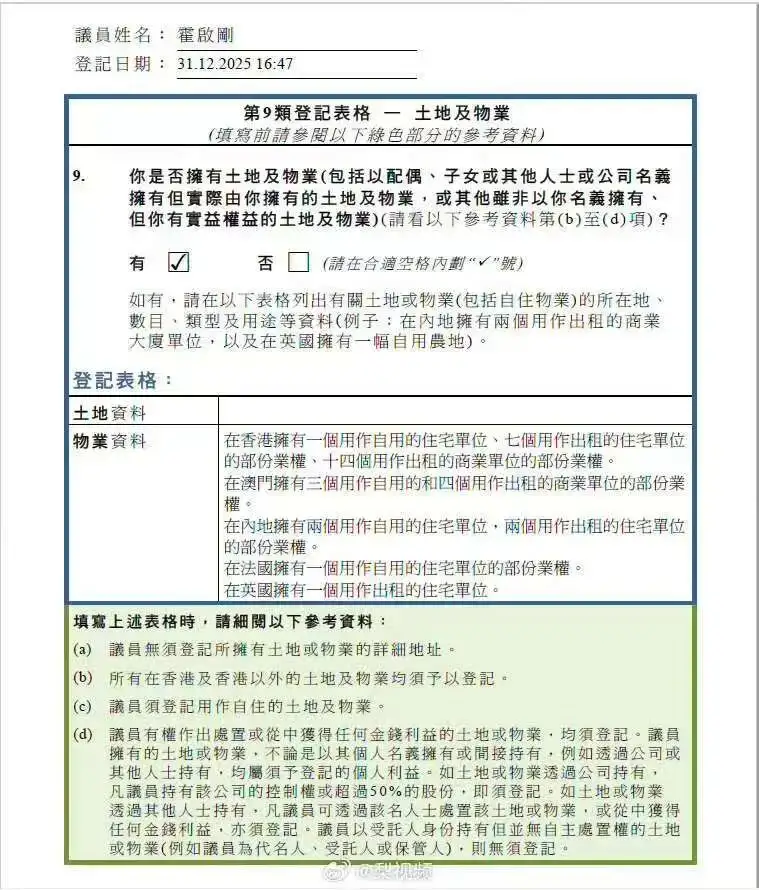
Kenneth Fok voluntarily disclosed the properties under his name, prompting many mainland netizens to exclaim "so candid" and "a breath of fresh air among prominent families," while some netizens joked that Kenneth Fok is a "global landlord."
But beyond the excitement of following the gossip, as a professional lawyer, I also became curious: does the mainland also have this kind of "full disclosure of family assets"? And what does it look like?
PART.01
The legal basis for "mandatory declaration": not a "recommendation," but "compulsory"
Many people assume that asset declaration is an "employer requirement," but in fact it is an obligation expressly prescribed by law:
- Civil Servant Law of the People's Republic of China
Article 57 of the Civil Servant Law expressly provides: "Civil servants shall abide by the law and disciplinary rules, and shall not conceal or distort the truth or engage in fraud," and asset declaration is precisely a core element of "truthfully reporting personal matters."
Simply put: failing to report is "unlawful," not merely a "violation of employer rules."
2. Provisions on the Reporting of Personal Matters by Leading Cadres
This is the most direct "operating manual," and it states clearly:
Who must report: leading cadres at the deputy section level and above, and middle-level and above personnel of state-owned enterprises (some regions extend this to "section-level staff in key positions");
What to report: 14 categories of content, including real estate, investments, and spouses' and children's business activities—even "the foreign nationality of spouses and children" must be stated;
When to report: reports are filed on a centralized basis every January, and reporting is "mandatory and subject to verification" before promotion or transfer.
PART.02
The "legal consequences" of concealment: not "a couple of words of criticism," but "accountability in accordance with the law"
The earlier example of "Old Zhang losing his bureau-director post" was not "the organization playing favorites"; the law had long since fixed the "penalty standards":
- The Disciplinary Regulations of the Communist Party of China
Article 73 provides: "Whoever conceals and fails to report personal matters, where the circumstances are relatively serious, shall be given a warning or a serious warning"; and if a person "fails to truthfully explain issues to the organization during organizational conversations or inquiries," the sanction is escalated directly.
(In plain terms: concealment = Party disciplinary sanction; a minor one is a warning, a serious one may mean "losing one's official post")
- The Supervision Law of the People's Republic of China
Article 45 of the Supervision Law expressly provides that public officials who "fail to truthfully report personal matters" may be given administrative sanctions such as "a warning, demerit, major demerit, demotion, or removal from office"; and if it is ascertained that there are "huge amounts of property with unidentified sources" or "concealed overseas deposits," the matter is directly transferred to the judicial authorities, where it may be convicted under Article 395 of the Criminal Law as the "crime of holding a huge amount of property with unidentified sources"—with a maximum sentence of 10 years!
Here is a domestic case:
A former chief procurator of a county procuratorate, in multiple declarations from 2007 to 2015, failed to report his wife's HKD 1,150 thousand in deposits at HSBC in Macao and the 2 Macao properties purchased with those funds; he was expelled from the Party and dismissed from public office and transferred to the judicial authorities, and was later sentenced to 1 year of fixed-term imprisonment for the crime of concealing overseas deposits, and, with the crime of accepting bribes joined in the same sentencing, to 11 years and 6 months.
The upshot: "concealment" first takes the "disciplinary lash," then faces "legal proceedings"—the double punishment is unavoidable.
PART.03
Why is it that the property declarations of domestic civil servants cannot be seen?
Why do we find Kenneth Fok's property declaration so novel? Since 'some leading officials' on the mainland also have a declaration obligation, why have we never seen their property declarations? This brings us to the boundary between the property declaration obligation and privacy protection, and the law has addressed this as well—
Article 17 of the Provisions on Leading Officials Reporting Personal Matters clearly states:
The personal-matters reporting materials of leading officials shall be 'kept by designated personnel and managed on a centralized basis' by the organization (personnel) department;
Accessing or copying reporting materials must be 'approved by the principal person in charge of the organ';
Anyone who discloses the contents of a report shall be held accountable directly under the Disciplinary Regulations of the Communist Party of China and the Law of the People's Republic of China on Guarding State Secrets, and in serious cases shall be 'subject to criminal sentencing.'
In effect: your property information is declared internally within the organization, but is confidential externally; anyone who dares to spread it is the first to break the law.
Why is Kenneth Fok's declaration 'more public'? This involves differences between the two systems:
Hong Kong's Rules of Procedure of the Legislative Council require members to 'publicly declare interests,' whereas the mainland system is 'internal control and confidentiality in accordance with law'—these are different designs based on the actual circumstances of the two places, but the core logic is the same: using institutions to curb 'collusion between power and interests.'
Kenneth Fok's 'public declaration' is a requirement of the Hong Kong system, while the mainland's 'internal declaration' is the 'supervision + confidentiality' balance prescribed by law—in essence, both embody the principle that 'power must be subject to supervision.'
One final point: whether it is 'public disclosure' or 'internal reporting,' the core of property declaration is to ensure that 'power operates in the sunshine.' For civil servants, 'declaring in accordance with law' is an obligation; for ordinary people, it is the legal safeguard that ensures 'power is not exercised arbitrarily.'
Having read this far, do you now have a clear understanding of the legal logic behind civil servants 'disclosing their assets'?
In fact, whether it is Kenneth Fok's 'global property map' or the 'declaration forms' of our mainland civil servants, the essence is to place a 'shackle of transparency' on power—both to protect officials from going astray and to give ordinary people 'peace of mind.'
Think this content understands the law and still keeps it real?
You are also welcome to follow me, and we will keep talking about these “serious yet fascinating” new developments from a legal perspective!

