
This morning I saw two news stories:
One was that Wang Xiaofei has started another round of erratic behavior. Because the quality of contract-manufactured products for his company, Ma Liuji, could not be guaranteed, its performance declined to the point where it was basically difficult to sustain. He therefore went to the Weibo account of a Douyin vice president and once again staged the routine of posting comments that drew public attention and then deleting them.
The other was that
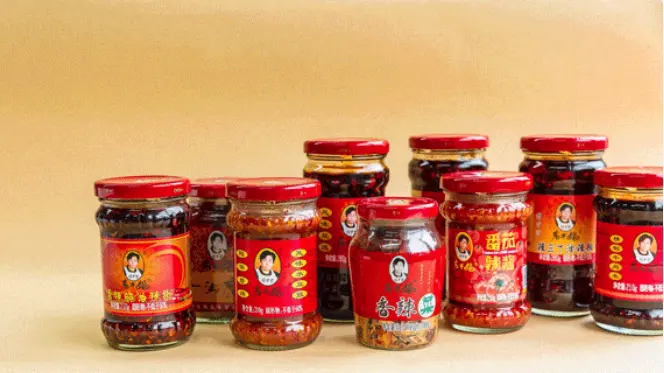
80-year-old Tao Huabi led Lao Gan Ma to deliver an impressive revenue result of 5391 million yuan in 2024, approaching its historical peak.
Comparing the two news stories really makes one sigh with emotion: this entrepreneur, known as the "godmother of China's national chili sauce," has demonstrated through 30 years of ups and downs that true corporate inheritance is not handing the company over to capital, but handing the flavor over to time. Returning to the fore at the age of 80 brings the inspiration of creating brilliance again, and there should also be the helplessness of an elderly entrepreneur.
Next, I want to write about how to hand responsibility over to the next generation that is worthy of being entrusted.
As a longtime Lao Gan Ma fan, I have to say: Ms. Tao, at 80, please safeguard Lao Gan Ma for the nation!
PART 01
Growth against the trend: the long-termism behind "anti-involution"
Today, when livestream selling and co-branded marketing are all the rage, Lao Gan Ma has instead taken a path back to fundamentals:
an "anti-involution" path. Since 2021, it has voluntarily stopped updating its social media, disbanded its livestream team, and refused equity investment from external capital. Yet its 2024 revenue grew by more than 7% compared with 2023, marking three consecutive years of positive growth, while its market share remained firmly at the top of the industry.
Where did this rare revenue growth come from?
- Extreme product focus: after Tao Huabi returned in 2019, she decisively abandoned lower-priced Henan chili peppers, fully restored the traditional Guizhou chili pepper formula, and, because of a flavor deviation, destroyed 500 tons of finished products worth tens of millions of yuan in one go.
- Channel dominance: The products cover 98% of county-level markets nationwide, with a supermarket distribution rate as high as 95%; international retail giants such as Walmart have set up dedicated shelf space for them.
- Strong overseas growth: The products are sold to more than 160 countries and regions, and in European and American markets they remain in short supply even at prices of USD 3–5; in 2023, overseas revenue growth exceeded 30%.
- User resonance effect: “Give me a bottle of Lao Gan Ma and I can finish two steamed buns” — this is not merely a consumer slogan, but further evidence of the repeat-purchase logic driven jointly by pragmatism and emotional connection.
PART 02
Succession arrangements: rigorously selected successor and the “Four Noes Principle”
As lawyers, seeing this news immediately brought to mind similar inheritance disputes we have encountered before. We therefore gathered the publicly available information on Lao Gan Ma’s inheritance arrangements:
Tao Huabi, aged 80, holds a clear and firm attitude toward family succession; from the choice of successor to the equity design, both reflect her distinctive “spicy wisdom.”
\1. Rigorous successor standards
Tao Huabi publicly confirmed her younger son, Li Miaoxing, as the company’s successor; his selection criteria combine traditional values with modern management needs:
- Strong technical capability: Li Miaoxing has driven the expansion of products from a single chili sauce to more than 20 categories, including hot pot base and fermented bean curd, demonstrating product innovation capability.
- A spirit of enduring hardship: long-term deep involvement on the production front line is consistent with Tao Huabi’s entrepreneurial philosophy of “building a business from nothing through hard work.”
- Filial piety and virtue first: Tao Huabi firmly believes that “filial piety and virtue” are the character foundation for a family business to endure.
\2. Carefully designed equity structure
- Li Miaoxing (second son): holds 50% of the shares and is responsible for production and internal management. After Li Miaoxing took over, during the period from 2014 to 2018, in order to respond to the continuous rise in Guizhou chili prices (from 12 yuan/jin to 15 yuan/jin) and rising labor costs, he began to gradually replace Guizhou chilies with Henan chilies (priced at 7-8 yuan/jin) and simplified the production process. Consumers generally reported that the product had "changed taste," causing its reputation to decline and its repurchase rate to fall from 80% to 60%. Lao Gan Ma's revenue declined continuously from 4389 million yuan in 2014 to 4 billion yuan in 2018, a decrease of approximately 10%. In 2019, Tao Bihua came out of retirement to correct the course!
- Li Guishan (eldest son): holds 49% of the shares and leads external investment. In 2021, he became involved in a debt dispute arising from an unfinished project (involving an amount of approximately 97570 thousand yuan). Guishan Tianyang Company, under his name, was repeatedly subject to restrictions on high consumption (19 times in total). Although legally independent, the public associated the conduct of family members with the brand, causing the brand search index to decline by 30% in 2021. In 2021, Tao Bihua once again came out of retirement to correct the course!
- Tao Huabi herself: retained only 1% of the equity, but maintained ultimate control over major decisions by serving as legal representative, and adhered to the four-no principles of "no listing, no loans, no controlling stake, and no equity participation." Although Tao Huabi has withdrawn from direct shareholding, she still serves as chairman and, by intervening in key decisions (such as switching back to Guizhou chilies in 2019 and cutting off real estate risks in 2021), actually holds the highest say. She even still lives in the factory area and personally participates in production management, and has not truly "retired to enjoy a peaceful life."
This equity structure design appears balanced--Li Miaoxing has relative control, and Li Guishan is close to safe control--but the lack of institutional arrangements such as a concert party agreement or a family committee has planted hidden risks for subsequent decision-making conflicts.
.
PART 03
When an 80-year-old founder still holds the overall situation: legal concerns of elderly governance and the urgency of succession
Although Tao Huabi remains vigorous and decisive in her decision-making, it cannot be denied that the 80-year-old founder's continued control of the enterprise's overall situation itself constitutes special legal and governance risks.
In a case I once handled, I encountered a similar elderly entrepreneur who had not arranged a suitable successor, resulting in his children litigating over the inheritance after his sudden death from an acute illness, debtors evading repayment, and what had originally appeared to be a sound enterprise turning into a mess that no one cleaned up, with family members becoming estranged.
This situation is not uncommon in family businesses, but when an elderly entrepreneur is still able to come out and save the enterprise in a time of difficulty, it is precisely the critical moment in family succession when the most advance preparation is needed.
\1. Real legal risks of elderly governance
- Continuity of decision-making: as age increases, a founder may suddenly become unable to perform duties due to health reasons. Without clear authorization or a decision-making transition mechanism, an enterprise is prone to falling into a "power vacuum," triggering internal turmoil.
- Risk to civil capacity: although Tao Huabi currently has full civil capacity, her advanced age may in the future give rise to doubts about her decision-making capacity, especially in major investments or equity disposals.
- Absence in emergencies: if the founder suddenly has a health problem, the enterprise may face operational difficulties such as frozen bank accounts and inability to sign major contracts, because many key authorities remain concentrated in the founder's hands.
2. The “double-edged sword” effect of Lao Gan Ma’s equity structure
The arrangement under which Tao Huabi retains only a 1% equity interest while serving as legal representative reflects her deep attachment to the company and her desire for control. Yet this model also carries latent concerns:
- Separation of control and ownership: tension may exist between a 1% equity interest and a 100% desire for control, particularly where she disagrees with her children, who hold a larger stake.
- Intergenerational decision-making friction: her two sons together hold 99%, yet the mother still holds ultimate decision-making authority through her status as legal representative; over the long term, this arrangement may require a clearer allocation of powers and responsibilities.
- The “last mile” challenge of succession: the company’s ultimate transition from “mother-led” to “sons taking over” still requires a clear legal point in time and procedure.
3. Common “pitfalls” in family business succession
From a legal perspective, many family businesses reveal succession problems only when their founders reach an advanced age:
- Absence or ambiguity of a will: as many as 60% of Chinese family business founders have not made a formal will, so equity inheritance can proceed only under statutory succession, which readily gives rise to disputes.
- Rigid equity structure: shares divided equally among multiple children lead to inefficient decision-making, trapping the company in a “family parliament” predicament.
- Lack of tax planning: equity succession entails substantial tax costs; without advance planning, the company may be forced to liquidate assets to pay taxes, affecting its operations.
- Involvement of collateral relatives: as the family expands, relatives such as spouses and grandchildren may assert rights and interests, complicating the equity structure.
4. A legal toolbox for a smooth transition
In addressing the succession needs of an elderly founder, modern law offers a range of tools:
- Inter vivos trust arrangements: Tao Huabi may place the equity into a trust, retaining control as a beneficiary while clearly specifying the ownership and management of the equity after her death, thereby avoiding inheritance disputes.
- Phased authorization and delegation: decision-making authority may gradually be delegated to a successor through written authorization, ensuring a smooth transition while allowing the authority to be withdrawn when necessary.
- Special charter design: the company's articles of association may provide for a "founder's conditional veto right" or establish a "family decision-making committee," so that succession proceeds according to established rules.
- Health contingency mechanism: a medical power of attorney and an emergency plan may be established in advance to specify the interim decision-making mechanism in the event of a sudden health issue affecting the founder.
\5. Lessons from Lee Kum Kee: Replacing Individuals with Institutions
Lee Kum Kee's approach to succession is worth considering. While the founder was still alive, the family began establishing a "family council" and a "family constitution," clearly defining the roles, rights and exit mechanisms of family members. This institutionalized arrangement means the enterprise no longer depends on any one person's health or decision-making ability, but operates through rules and systems. When differences arose among the second generation, the third generation achieved a smooth transition through an internal equity buyout—precisely the power of institutions.
PART 04
Future challenges: Lao Gan Ma at the crossroads of succession
Standing at a new high of 5400 million in revenue, Lao Gan Ma faces not only market challenges but also a profound test of succession:
- Succession timeline: Tao Huabi is already 80 years old, and a complete transition of the enterprise from "mother's oversight" to "the son in charge" requires a clear timetable and roadmap.
- Cultivation of the third generation: Li Miaoxing is also approaching sixty, and whether and how the grandchildren will enter the enterprise requires early planning.
- Transformation of the decision-making mechanism: how to transition smoothly from "the founder's sole say" to "institutionalized decision-making" is key to the enterprise's enduring success.
- International market compliance: As overseas operations expand, complex legal issues such as international inheritance law and trust law will also emerge.
PART 05
Conclusion: The best time for succession is while the founder is still alive
Tao Huabi, at the age of 80, still inspects the factory every day. This is admirable, and it also reminds us that the best time for family business succession is not after the founder passes away, but while they are still healthy and clear-minded.
The story of Lao Gan Ma tells us that a company's success can rely on a strong founder, but a company's enduring vitality must rely on a comprehensive system. The flavor of chili sauce requires time to develop, and business succession requires even more advance planning. This bottle of chili sauce, familiar to Chinese people, stands at the crossroads of tradition and modernity, family and system, individual and institution. Its choice will provide a vivid lesson in succession for tens of thousands of family businesses in China.
True wisdom in succession is not about never letting go, but about handing the baton to the next generation at the appropriate time and in the appropriate manner—this perhaps requires even more courage and foresight than generating 5400 million in revenue.
With the development of Chinese society, those star first-generation entrepreneurs are gradually growing older. This is not only a challenge for Lao Gan Ma alone, but also an era-defining question facing all Chinese family businesses.
You are welcome to follow me and leave your views in the comments section. How do you think family businesses should balance the founder's control with intergenerational succession? Do you have examples of successful or failed succession around you?

