
This is the 11th of 100 legal commentaries in 2026. I previously wrote an article on this incident—
800 thousand to "buy out" 3 lives? The compensation dilemma in the Jingdezhen speeding case and practical guidance for lawyers
, and now the follow-up has arrived~
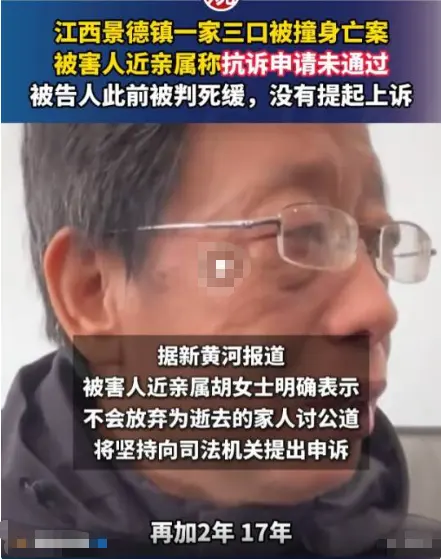
On the afternoon of January 26, the Jingdezhen Municipal People's Procuratorate formally replied rejecting the victims' family's application for protest. In this "case of a family of three killed by a collision" that has drawn widespread public attention, after the first-instance judgment sentenced the defendant Liao to death with a two-year reprieve, the victims' family expressed strong dissatisfaction and sought a harsher sentence through protest proceedings, but encountered a procedural setback.
The defendant Liao did not appeal, so the case has now entered the review stage. Once the Jiangxi Provincial Higher People's Court approves it upon review, the judgment in this case will formally take effect.
For a family that has lost three relatives, this is undoubtedly a heavy blow.
01 Current Case Progress
The case has entered the review stage and is being reviewed by the Jiangxi Provincial Higher People's Court. Once the review is approved, the first-instance judgment will take effect.
The procuratorate rejected the victims' family's application for protest, meaning that the procuratorate considers the first-instance judgment not to be manifestly improper and does not support initiating second-instance proceedings.
02
After the protest was rejected, what legal avenues remain for the family?
As the author analyzed in the previous article, the likelihood of a procuratorate protest was low. The family mentioned that if the petition fails, they would seek to protect their rights through civil litigation; however, owing to the legal characterization of the case, civil litigation may likewise fail to achieve the expected outcome (
800 thousand to "buy out" 3 lives? The compensation dilemma in the Jingdezhen speeding case and practical guidance for lawyers
As analyzed above, once it is determined to be
the crime of endangering public safety by dangerous methods,
the death compensation and mental distress compensation, which account for the bulk of the compensation amount, cannot be claimed).
As for legal procedures, although the application for protest was rejected, the law still provides victims' family members with multiple remedies:
1. File a petition with the People's Court
- Who may petition: The victim and their legal representatives and close relatives all have the right to petition.
- Time for petition: The law does not set a clear time limit, but it is advisable to file as soon as possible after the judgment takes effect.
- Materials to prepare: A petition (setting out in detail the facts and grounds for the petition), the original judgment, the ruling and other legal documents. Any new evidence or relevant leads should also be submitted together.
- Handling process: The People's Court will review the petition. If it finds statutory circumstances such as new evidence in the case, insufficient evidence in the original trial, or erroneous application of law, it will initiate trial supervision proceedings for retrial; if the conditions are not met, the petition will be rejected.
2. File a petition with the People's Procuratorate at the next higher level
- Petitioning parties: Likewise the victim and their legal representatives and close relatives.
- Time limit for petition: Generally, the petition should be filed within five days after receiving the decision rejecting the protest.
- Appeal materials: A detailed explanation of the grounds on which the protest was rejected, as well as the legal basis for the view that the original judgment contains errors, is required; relevant evidentiary materials may be attached.
- Outcome: After review, if the people's procuratorate at the next higher level considers the grounds for protest to be well-founded, it may direct the people's procuratorate at the lower level to lodge a protest; if it considers the protest to be improper, it will uphold the original decision.
3. Applying for judicial assistance
- Applicable circumstances: If a victim's family, as a result of the criminal infringement, is unable to obtain full compensation through litigation and falls into hardship in daily life, it may apply for judicial assistance.
- Assistance providers: Courts and procuratorates may, on application or on their own initiative, grant assistance funds to eligible victims, and may also assist in connecting them with social assistance resources such as civil affairs departments and charitable organizations.
- Application process: Submit an assistance application to the local court or procuratorate, explaining the family's hardship and its connection to the case; upon review and confirmation of eligibility, the corresponding assistance will be granted.
03 Legal measures alone may be insufficient to heal the trauma
This tragedy did not end with a written judgment, and the victim's family members certainly do not accept it. Such developments also touch upon the real-world dilemma currently faced by cases in the tension between procedural and substantive justice.
From the perspective of legal practice, there is also some room for maneuver within the legal framework. We can understand this from the following aspects:
1. The current state of legal procedure: Conventional paths are indeed limited, from a purely procedural-law perspective:
- Insufficient basis for protest: The procuratorate's rejection of the protest means that, after review, the procuratorial organ considered that the first-instance judgmentfact-finding, admission of evidence, or application of lawthere is no obvious error or impropriety, and the conditions for protest prescribed by the Criminal Procedure Law are not met. This is more a judgment based on legal technicalities.
- No second-instance proceedings were initiated: because the defendant did not appeal and the procuratorate did not protest, the first-instance judgment will take effect after review by the High Court.The ordinary second-instance proceedings initiated by the parties to the litigation have indeed been closed.
Practical difficulties and potential possibilities where the procedure is "blocked"
The family's feeling that the path to vindicating their rights has been blocked is a very real and painful one. This arises mainly from:
- The gap between emotional demands and legal judgment: there is a difficult-to-bridge gap in understanding between the family's demand for "immediate execution of the death penalty" and the "death sentence with a two-year reprieve" rendered by the judicial authorities based on all the evidence and circumstances (such as whether there was voluntary surrender, whether compensation was actively paid, subjective culpability, and so on).
- The mismatch between procedural rigidity and the timing of mediation: mediation work is usually conducted during thetrial stage(especially during the first-instance proceedings) was the most active and effective. Once the judgment takes effect, the criminal portion is settled, and the defendant's motivation to make substantive compensation and express remorse may change.
However, even under the current procedures, there remains some legally possible room for action:
Path One: Seeking the attention of the highest judicial authorities during the review stage
- The case is currently at thereview stage before the Jiangxi Provincial High People's CourtAlthough the review primarily examines the legality of the first-instance judgment, if during the review process the High People's Court finds that the case involves special considerations regarding social impact, sentencing consistency, or the resolution of conflicts,there is in theory an extremely small probabilitythat it will decline to approve the judgment on the grounds of "unclear facts" or "inappropriate sentencing" and remand the case for retrial.
- The family members and the representing lawyers may, through formal channels, submit detailed written opinions to the review collegial panel, emphasizing the social harm of the case, the extreme suffering of the family members, and the current situation in which no adequate compensation or settlement has been obtained, in an effort to attract attention during this last routine review procedure.
Path Two: Initiating trial supervision procedures through an appeal, creating a new window for mediation
- After the judgment takes effect, the appeal lawfully filed by the family membersappealis a lawful avenue for initiating trial supervision proceedings (retrial).
- Retrial review examines not only errors of law but also considerssocial effects and the resolution of conflictsIf, during the appeal process, or when the court or procuratorate is reviewing the appeal, family members can facilitatethe defendant demonstrating great sincerity in remorse and willingness to compensate, this in itself may become a "new circumstance" prompting the judicial authorities to re-examine the circumstances of the entire case.
- At this point,mediation efforts may be restartedIf a conditional settlement agreement can be reached at the retrial review stage(such as the defendant making substantial compensation, publicly repenting, etc.),this settlement agreement will become important material for demonstrating to the court or procuratorate that "the case has new developments and the conflict may be resolved"Important materials, and may even affect subsequent proceedings.
Path Three: Pursue the criminal appeal to the end, creating pressure and an opportunity
- Treat “whether the defense sincerely performs compensation” as thecore indicatorof whether the defendant is genuinely repentant and whether the defendant deserves some consideration in criminal terms (even after a judgment has taken effect), and maintain ongoing communication with the judicial authorities on this basis.
Conclusion: Seeking substantive justice in the gaps between procedures
Indeed, from a purely legal-procedure perspective, the ordinary avenues for relief have narrowed. However, in Chinese judicial practice, “resolving the case and concluding the matter” and “resolving social conflicts” are likewise important value pursuits.
The conclusion of proceedings does not mean the end of all efforts and possibilities.
For the family members, the current strategy may need to shift from the single objective of “seeking a change of judgment” to a more comprehensive and longer-term objective:
using all lawful channels (appeals, enforcement, and petition-related communication) to continue speaking out, because even if this cannot influence a change of judgment, it can still influence commutation of sentence.
At the same time, we have always kept the door to mediation and settlement open, and have continuously presented to the judicial authorities the defendant's subsequent compensation and expressions of remorse as the yardstick for measuring whether his subjective culpability and social harm have been reduced.
This path is exceptionally difficult, requiring tremendous perseverance, professional legal strategy, and a precise grasp of the social effects.
It is not a confrontation with legal proceedings; rather, it is a search, within the interstices of legal proceedings and in subsequent stages, for the greatest possible substantive justice and spiritual solace that the law permits.
Even if the judgment ultimately cannot be changed, this process itself may, in terms of the realization of compensation and emotional recognition, secure for the family somewhat more compensation and dignity than passive acceptance would afford.
If this article has given you a clearer understanding of the legal characterization and compensation-based rights protection in this trending news story, you are welcome to follow, like, and share it, so that more people understand legal risks and maximize their rights-protection interests. If you have any questions about subsequent developments in the case or related legal issues, you may also leave a comment below, and I will provide you with a professional answer!

