
This is my 17th/100 legal commentary article of 2026. This spring, the stories of three women intertwined in public discourse, sketching the complex spectrum of women's lived reality in this era. When Ma Xiaomei, wife of Wang Xiaofei, gave birth, the social media blessings of "winner in life" faintly betrayed outdated judgments. After Winter Olympic champion Xu Mengtao defended her title in Milan, Xu Mengtao's father said he hoped Xu Mengtao would have a child, and the comment section filled with a wave of urging-fertility netizens and netizens posting fertility urgings, making the controversy this triggered as conspicuous as her gold medal. And Eileen Gu, after two silvers at the Winter Olympics, withstood the pressure and fought to win gold. Three stories, three lives, yet facing a similar soul-searching question: who, after all, should define a woman's value?
01 The Landscape of Women's Lives Through Three Lenses

Inside and Outside Ma Xiaomei's Delivery Room: The Value Predicament Behind "Fulfillment"
On the seventh day of the first lunar month in 2026, Ma Xiaomei gave birth—which should have been purely joyful news. Yet when discussions of "the mother gains status through the child," "her position is secure," and "my heart goes out to Da S's two children" came to dominate the conversation, the problem became apparent.
Childbearing was reduced to a kind of "achievement" or "bargaining chip," rather than a woman's autonomous life choice. Tellingly, Ma Xiaomei herself once responded calmly: "My child does not need to fight over Wang Xiaofei's property; my own family has plenty." Behind this statement lies a woman's clear-eyed understanding of her own value—her value does not depend on continuing the family line for her husband's household, but stems from her own confidence and independence.
Inside and Outside Xu Mengtao's Arena: The "Urging to Have Children" Gaze That a Gold Medal Cannot Mask
Even more thought-provoking is Xu Mengtao's situation.
At 36, she has just completed a title defense rarely seen in Olympic history—the ultimate expression of the sporting spirit safeguarded by the Sports Law.
However, some public commentary, when Xu Mengtao said she intended to challenge for the next Olympic Games, showed unusual "concern" about her childbearing plans.
"No matter how successful your career, it is not complete without having a child"—such remarks not only belittle her professional achievements but also arguably interfere with her legally protected right to reproductive self-determination.
Faced with these voices, Xu Mengtao's response was: "I will strive for one more Olympic Games." This is a defense of professional dignity and a mastery of the rhythm of her own life.
Eileen Gu's Multiverse: Undefined Infinite Possibilities
Meanwhile, Eileen Gu continues after the competition to live a life that is “not to be defined”—excelling academically at Stanford, shining in the fashion world, and demonstrating excellence across fields. Her very existence is expanding the boundaries of what society imagines as possible for women. Outspoken and brilliant, she has also faced considerable questioning and resistance rooted in utilitarian views of education.
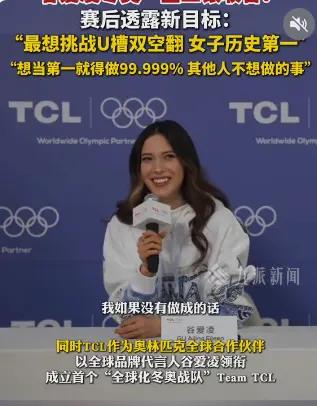
At the post-competition press conference, she choked up as she mentioned her grandmother, who had just passed away: “The greatest wealth she left me is the courage to be myself and to take charge of my own life.” That sentence could almost serve as a declaration of contemporary women’s values. Three women, three choices, yet facing similar judging gazes.
02 The gap between legal protection and lagging attitudes

The online debate has exposed a deep-seated contradiction in social attitudes:
One side views this as the “traditional care” of those with more life experience and elders who mean “it’s for your own good”; the right to reproduction is itself protected by law, and there is nothing wrong with expressing concern.
The other side points out that the problem is not reproduction itself, but the use of reproduction as the primary or even sole criterion for evaluating women’s worth. As a professional gossip blogger, I feel compelled to offer some legal education: excessive concern may cross the line from a legal perspective:
- It is suspected of violating the core spirit of the Law on the Protection of Women’s Rights and Interests: that law explicitly provides for the elimination of gender-based stereotypes and prejudice. Overly tying women’s worth to reproduction is precisely the kind of stereotype that needs to be discarded.
- It infringes on the “right to reproductive self-determination”: the core of reproductive rights lies in “free decision-making,” and excessive public attention to and commentary on others’ reproductive plans constitutes improper interference.
- It demeans women’s professional and social achievements: evaluating outstanding women such as Olympic champions by their marital and reproductive status is in substance a covert disparagement of their social contributions, and runs counter to the right to equal development protected by law.
Legal progress has provided women with a solid foundation of rights, but attitudes have been slow to change. This era has given women unprecedented room for choice, yet outdated yardsticks in public discourse are still trying to measure every woman’s life. I have even encountered cases in which differing views on reproduction led to the breakdown of a marriage. In some, one spouse wanted children and the other did not, and they ultimately chose to divorce; the spouse who wanted children regarded the refusal to reproduce as a marital fault and demanded that the spouse who refused to reproduce receive a smaller share of property. Of course, this situation does not constitute a statutory fault and does not affect the property division ratio. In others, the wife had an abortion without the husband’s consent, and the husband, in a fit of anger, sought a lawyer. This raises the question of whether the right to abortion belongs to women alone. There is indeed a legal basis: Article 21 of the Law of the People’s Republic of China on the Protection of Women’s Rights and Interests (hereinafter referred to as the “Law on the Protection of Women’s Rights and Interests”) provides: “Women’s rights to life, bodily integrity and health shall be inviolable. Acts of maltreatment, abandonment, maiming, trafficking and other acts infringing on women’s rights and interests in life and health shall be prohibited. Fetal sex identification for non-medical purposes and sex-selective artificial termination of pregnancy shall be prohibited. When medical institutions perform reproductive surgery, special examinations or special treatment, the consent of the woman herself shall be obtained; where the woman’s views differ from those of her family members or related persons, the woman’s own wishes shall be respected.” Article 32 of the Law on the Protection of Women’s Rights and Interests provides: “Women shall enjoy the right to bear children in accordance with law, and shall also have the freedom not to bear children.” Article 19 of the Law of the People’s Republic of China on Maternal and Infant Health Care (hereinafter referred to as the “Maternal and Infant Health Care Law”) provides: “Termination of pregnancy or sterilization performed in accordance with the provisions of this Law shall be subject to the consent of the person herself and her signed opinion; where the person has no capacity for civil conduct, the consent of her guardian and the guardian’s signed opinion shall be obtained. Where termination of pregnancy or sterilization is performed in accordance with the provisions of this Law, the services shall be provided free of charge.” Conclusion: under the relevant provisions of the Law on the Protection of Women’s Rights and Interests and the Maternal and Infant Health Care Law, women enjoy the right to bear children and the right not to bear children. Even where a woman and her spouse cannot reach agreement, the hospital shall act in accordance with the woman’s wishes, and the surgery may be performed once the woman herself has signed the surgical consent form, without the need for the spouse’s signature or consent.
03 Reclaiming the power to define: this is the best of times

This is an unprecedented era—the law is advancing, choices are increasing, and possibilities are expanding.
The Civil Code safeguards every person's human dignity and autonomy, while the Law on the Protection of Women's Rights and Interests is dedicated to eliminating gender discrimination and ensuring women's equal development in all fields. These legal provisions are not merely promises on paper; they are weapons that women can take up to defend themselves.
Ma Xiaomei's economic independence, Xu Mengtao's professional pursuit, and Eileen Gu's multifaceted development—on different tracks, they are practicing the same thing: keeping the power to define their lives firmly in their own hands.
- Ma Xiaomei's confidence comes from her economic autonomy—"my own family has it"—which means she need not prove her worth or trade for security through childbirth.
- Xu Mengtao's resolve is reflected in her professional pursuit of "competing in one more Olympic Games"; her value is demonstrated first and foremost on the field of competition, not in any social clock.
- Eileen Gu's declaration—"be brave and be yourself, take charge of your own life"—articulates the core of women's awakening in this era: we are no longer passive recipients of any evaluation system, but active creators of our own lives.
The greatest gift this era offers women is not a single "template for success," but women's unprecedented
right to choose and opportunities
You may choose to become a mother, or you may choose to focus on your career; you may choose a traditional path, or you may forge an entirely new track. The key is that this is your clear, autonomous choice.
- The law is your armor, defending against the encroachment of outdated attitudes.
- Economic independence is your confidence, supporting you in making free choices.
- Diverse role models are your lighthouse, illuminating more possibilities.
Dedicated to every woman:
Your life does not need to be lived as a template for trending topics, nor must it conform to others' expectations. You can, like Ma Xiaomei, maintain an independent sense of security in intimate relationships; you can, like Xu Mengtao, continue pursuing your dreams at the peak of your career; you can, like Eileen Gu, shine across multiple fields.
When society still measures women's value with old yardsticks, the best response is not anger, but living out your own dimensions.
Be brave enough to be yourself and take charge of your own life—this is not only the legacy of Eileen Gu's maternal grandmother, but should also be an inner echo for every woman in this era.
In the script of your life, you are the only author. Please write a unique story in the way you want.

