
The company has been two months late on wages—I taught my friend a move to win decisively
This article follows up on the situation described earlier: what should you do when the company refuses to pay the settlement amount? The process and text templates are recorded here, ready to use directly!
Many workers assume that "mediation = case closed," but when the mediation agreement expires, the company simply disappears. In fact, a mediation statement has the same effect as a court judgment; if the other party fails to perform, we can directly apply to the court for compulsory enforcement.
Why can we directly apply for compulsory enforcement?
Under Article 51 of the Law of the People's Republic of China on Labor Dispute Mediation and Arbitration:
The parties shall perform a legally effective mediation statement or award within the prescribed time limit. If one party fails to perform within the time limit, the other party may apply to the people's court for enforcement in accordance with the relevant provisions of the Civil Procedure Law.
This means:
- Labor arbitration mediation statement: It becomes legally effective on the date both parties sign for receipt, with no need to wait, and is enforceable.
- Labor arbitration award: If the company does not file a lawsuit within 15 days after receiving the award, the award becomes effective.
An effective arbitration document = a court judgment. If the company does not pay voluntarily, you have the right to ask the court to step in and take real action.
Practical steps for applying for compulsory enforcement
Step 1: Confirm the time limit (do not let it expire!)
The limitation period for applying for compulsory enforcement is two years.
Starting point: calculated from the last day of the performance period specified in the mediation statement or arbitral award.
For example, if payment is agreed to be made on April 1, the two-year limitation period starts on April 2. Once the period expires, you will lose the right to apply for enforcement.
Step 2: Determine the court with jurisdiction
Submit the application to the basic-level people's court of the place where the person subject to enforcement (the company) is domiciled or where the property subject to enforcement is located.
Usually, this is the district or county people's court where the company's registered address is located.
Step 3: Prepare case-filing materials
When going to the court's case-filing division (or filing online), please bring the following materials:
- Application for compulsory enforcement (original, signed and with a fingerprint).
- Effective legal document (original + photocopy): the labor arbitration award or arbitration mediation statement, and proof of effectiveness (some arbitration institutions provide the service receipts for both parties).
- Identity document: a photocopy of your ID card.
- Company information: a printout of the company's business registration information from the National Enterprise Credit Information Publicity System.
- Payment Account Confirmation: Provide your bank card number and account-opening bank for the court to remit payment.
Step 4: Submit the application
- Offline: Go directly to the court's litigation service hall (courts in first- and second-tier cities handle a large volume of cases; filing a case in person at the court requires taking a queue number, so allow sufficient time).
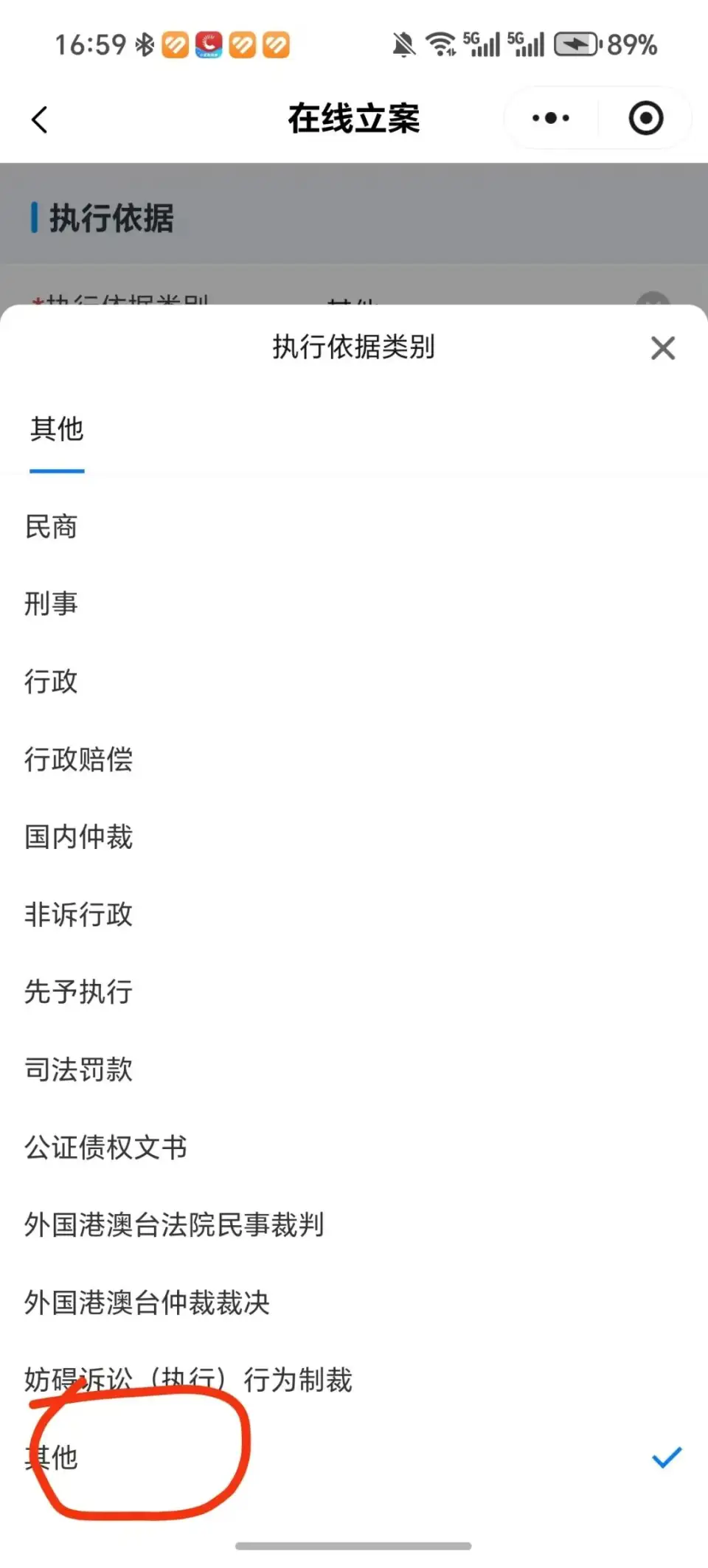
- Online: Submit through the WeChat mini-program "People's Court Online Service" (you can submit at any time and from any place; the court generally gives a review result within 7 working days; when making your specific selections, pay attention to the content selections shown in the following images).

What happens after the court accepts the case?
- Nationwide asset inquiry and control: The judge will use the system to check the company's bank deposits, WeChat/Alipay accounts, real property, vehicles, and other assets, and will directly freeze and deduct funds.
- Credit discipline: If the company has no money or has money but refuses to pay, the court may include it in the list of "dishonest judgment debtors" (the blacklist of deadbeat debtors) and restrict the legal representative's high-value consumption (no flying, no high-speed rail).
- Criminal liability: In serious circumstances, the person in charge of the company may be sentenced to imprisonment for the crime of refusing to execute a judgment or ruling.
Application for Compulsory Enforcement (Standard Template)
You can directly copy the following content, fill in the specific information, print it, and submit it.
Application for Compulsory Enforcement
Applicant for enforcement (employee): Name: [your name], Gender: [male/female], Date of birth: [XXXX] year [XX] month [XX] day, Ethnicity: [Han/other], ID card number: [your ID card number], Address: [your ID card address or current residential address], Contact phone: [your mobile phone number]
Respondent subject to enforcement (company): Name: [full name of the company that defaulted on wages]; Unified Social Credit Code: [91XXXXXXXXXXXXXX] (if unknown, you may search on Qichacha); Domicile: [registered address on the company's business license]; Legal representative: [name of the boss/legal representative]; Position: [general manager/executive director]; Contact telephone: [company telephone]
Application matters:
1. Request that the Respondent subject to enforcement be compelled in accordance with law to pay the Applicant for enforcement RMB [specific amount];
2. Request that the Respondent subject to enforcement pay interest on the debt for the period of delayed performance (calculated on the base of RMB [specific amount], from the date of expiry of the performance period specified in the mediation statement/award until the date of actual full payment, at a daily rate of 0.0175%);
3. The enforcement costs of this case shall be borne by the Respondent subject to enforcement.
Basis for enforcement:
Arbitration Award/Mediation Statement No. [XXXX] of [20XX] issued by the Labor and Personnel Dispute Arbitration Commission of [XX City, XX District].
Facts and reasons:
In the labor dispute between the Applicant for enforcement and the Respondent subject to enforcement, the Labor and Personnel Dispute Arbitration Commission of [XX City, XX District] issued Arbitration Award/Mediation Statement No. [XXXX] of [20XX] on [X] [month] [20XX]. That legal instrument has taken legal effect and determines that the Respondent subject to enforcement shall pay the Applicant for enforcement [wages/compensation/overtime pay] totaling RMB [specific amount] by [X] [month] [20XX].
However, as of the date of this application, the performance period specified in the above legal instrument expired long ago, and although the Applicant for enforcement has repeatedly demanded payment, the Respondent subject to enforcement has continued to evade payment on various grounds and refuses to perform the obligations specified in the effective legal instrument. In order to protect the lawful rights and interests of the Applicant for enforcement, this application for compulsory enforcement is hereby submitted to your Court pursuant to the relevant provisions of the Civil Procedure Law of the People's Republic of China.
Respectfully submitted,
People's Court of [place where the company is located]
Applicant for enforcement (signature/fingerprint):
_
Date: [X] [Month] [X], 202[X]
📎 Please attach the following documents when submitting:
- This application (original, in duplicate).
- The arbitral award/mediation statement (original and copy) and proof of effectiveness (some arbitration institutions provide the proof of service for both parties, issued by the labor arbitration body).
- A copy of the applicant's identity card.
- The company's business registration information printout (printed from the National Enterprise Credit Information Publicity System).
- If you have any leads on the company's assets, provide those asset leads as well.
- Bank card information in your own name that can receive the enforcement proceeds (in addition to the account holder and card number, you must also ascertain the account-opening bank) — this must also be provided!
The Lawyer's Final Reminders
- Do not casually sign a "settlement agreement": some companies may approach you during the enforcement stage to discuss "installment payments"; be careful not to readily sign any agreement waiving your enforcement rights unless the money has already been received.
- Proactively provide asset leads: although the court's investigation and control measures are powerful, you often know the company's operating conditions better (such as payment QR codes, hidden equipment, etc.); actively providing leads can help you obtain the money faster.
- On interest: even if the mediation statement does not provide for interest, the law requires that late payment penalties be paid when payment is not made after the deadline. Remember to include this item in the application; this is your statutory right.
The law does not protect those who sleep on their rights. When dealing with an unscrupulous employer, obtaining a favorable judgment is only the first step; promptly applying for compulsory enforcement is the key move to recover your hard-earned money.

