
In family law cases, "litigation is all about evidence." Many clients ask during consultations: "I want to get a divorce—what materials do I need to prepare?"
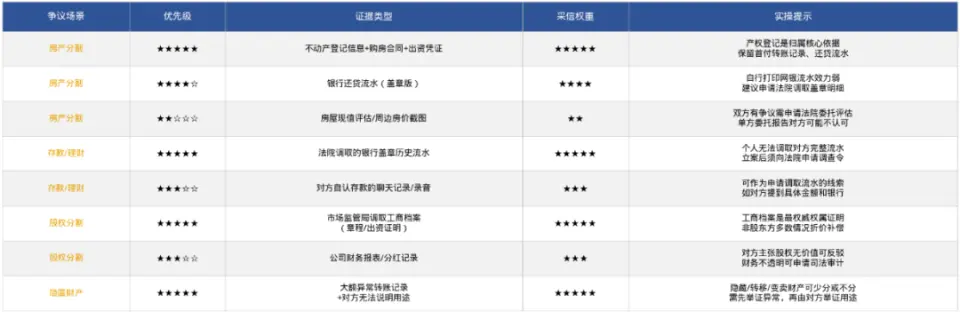
To that end, I have compiled this divorce case evidence collection checklist and a priority table for different claims, covering four core areas—marital relationship, breakdown of affection, child custody, and division of property. You may wish to save it for future reference.
I. Basic evidence of the marital relationship (any one of the following will suffice)
- Marriage certificate: If the certificate is lost, you may apply for a replacement with the original marriage registration authority or the marriage registration authority at the place of one party's permanent residence by presenting the household register and identity card. If the other party is unwilling to apply for a replacement, the Marriage Registration Review Form may be obtained from the marriage registration authority;
- Household register: If both spouses are registered in the same household register, it may directly serve as proof of the marital relationship;
- Archival certification materials: Records of the marital relationship contained in personnel files, household registration files, and similar materials;
- Certification by a grassroots organization: For a de facto marriage, a certificate of marital relationship may be issued by the village committee or residents' committee;
- Materials issued by official authorities: a marriage relationship certificate issued by the civil affairs department, and household registration information issued by the public security authority;
- Electronic certificates: electronic marriage certificates that can be queried through official channels such as the National Government Service Platform and Alipay.
II. Evidence of breakdown of affection and of divorce damages
(1) Proving bigamy/cohabitation with another person
- Witness testimony from persons with knowledge, such as neighbors, relatives and friends;
- Proof of the relationship publicly disclosed by both parties (such as household registration, jointly signed medical materials, archival information, etc.);
- Birth medical certificates of children born out of wedlock, paternity testing reports, etc.;
- Letters of guarantee and letters of repentance issued by the party at fault;
- Chat records, call recordings, intimate photos/videos, etc. of the parties' interactions;
- Records of transfers by the party at fault to an extramarital person of the opposite sex, joint rental contracts, hotel check-in records, etc.
(2) Proving the commission of domestic violence
- Injury evidence: Take clear photographs of the injuries immediately after they are sustained; the face must also be photographed to establish the injured person's connection to the case;
- Medical records: Seek medical treatment promptly and retain all medical records, including outpatient medical records, diagnostic certificates, examination reports, and inpatient medical records;
- Police reports and records of public authorities:
- Written admissions: When the party at fault apologizes, that party may be asked to write a letter of undertaking or a letter of repentance in his or her own hand, which should be retained;
- Witness testimony: Testimony may be collected from relatives, friends, and neighbors who have knowledge of the matter, and witnesses may be requested to appear in court where necessary;
- Audio and video evidence: Cameras may be installed in concealed locations in the home; when violence occurs, it is advisable to move to areas covered by public surveillance where possible, and attention should also be paid to dashcam footage, residential compound surveillance, and other relevant recordings that may be retained;
- Records of third-party institutions: You may seek help from the residents' committee, the women's federation, your employer, your school, and other such institutions, and retain the relevant records of visits and mediation.
(3) Proving abandonment of family members
- Witness testimony from relatives, neighbors, residents' committee staff, and others;
- Chat records, call recordings, transfer records, and the like showing the other party's refusal to pay support or child support.
(4) Proving repeated and uncorrected bad habits such as gambling, drug use, and excessive drinking
- Witness testimony from relatives, friends, and neighbors;
- Written guarantees and letters of repentance issued by the party at fault, and relevant conversation recordings;
- WeChat group gambling records, transfer records related to gambling or drug use, administrative penalty decisions concerning gambling or drugs, and the like.
(5) Proving separation for a full two years due to marital discord
- A separation agreement signed by both parties;
- Residence certificates issued by the property management company, the residents' committee, or the police station, and urban residence permits or electronic residence permits;
- Witness testimony from children, relatives, friends, and other persons with knowledge of the matter;
- Materials capable of corroborating the fact of separation, such as WeChat chat records, call records, public transportation travel records, housing lease contracts, and navigation records.
(6) Evidence of disputes over reproduction
- Records of induced abortion procedures issued by hospitals, medical treatment records, and the like;
- Chat records and call recordings of disputes between the parties over reproductive issues;
- Witness testimony from persons with knowledge of the matter.
(7) Materials concerning prior marriage litigation
Previously executed divorce agreements, divorce judgments/mediation statements issued by courts, rulings permitting withdrawal of actions, and the like.

III. Evidence relating to child custody
(1) Evidence of the child's identity and age
- The child's medical birth certificate, household register, and one-child certificate;
- Household registration certificates issued by public security authorities and parent-child relationship appraisal opinions;
- Parents' personnel files, the child's student status files, the page of the medical birth certificate bearing the parents' signatures, and the like.Note: In principle, a child under 2 years of age lives with the mother; for a child 8 years of age or older, the child's true wishes must be respected. Evidence concerning these age thresholds is particularly important.
(2) Evidence of day-to-day caregiving
- Photos and videos of day-to-day care of the child (which may be organized by year to show continuity of companionship);
- Receipts for living expenses, education expenses, medical expenses and extracurricular class fees paid for the child, screenshots of online shopping orders, etc.;
- School-home communication records, chat records with teachers, records of signing homework, sign-in records for parent-teacher meetings, etc.;
- Records of picking up and dropping off the child, vaccination records, medical examination reports, etc.;
- Witness testimony, travel records, etc. showing that the other party has long worked in another location and rarely returned home to care for the child
(3) Evidence of the financial capacity of both parties
- Income certificates issued by the employers of both parties, bank statements for salary cards, and evidence of business income or other income;
- Evidence of premarital personal real property, equity interests and deposits; where conditions permit, evidence of the parents' financial situation may be provided to corroborate the ability to support the child.
(4) Evidence of the child's actual expenses
Tuition payment receipts, extracurricular tutoring class contracts and payment records, records of day-to-day shopping and consumption, medical expense receipts, the child's commercial insurance policies, etc.
(5) Evidence of the child-rearing conditions of both parties
- Academic degree certificates, teacher qualification certificates, childcare worker certificates, and other qualification certificates related to the child's education;
- Recent medical examination reports of both parties, records of sterilization surgery, and medical records showing whether either party suffers from a long-term incurable infectious disease or any other disease rendering the party unsuitable to raise the child;
- Evidence of the health status of the paternal/maternal grandparents and their willingness to assist in raising the child;
- Relevant evidence as to whether one party has other children and whether the other party has no other children (such as birth certificates of the other children, prior divorce judgments or rulings, etc.).
(6) Evidence of the child's wishes
A written statement by a child aged 8 or above expressing willingness to live with one party, or audio recordings, videos, chat records, or other materials capable of reflecting the child's true wishes.

IV. Evidence of Marital Community Property, Claims and Debts
(1) Real property
- The house sale and purchase contract, purchase invoices, tax and fee payment receipts, and the real property ownership certificate;
- The housing loan contract and bank loan repayment statements/repayment records;
- The house lease contract, property management fee payment records, and evidence of the actual use of the property;
- Screenshots of market sale prices for comparable nearby properties and appraisal reports, to corroborate the current value of the property.
(2) Vehicles
- Vehicle purchase contract, vehicle purchase invoice, motor vehicle registration certificate, driving license, and vehicle insurance policy;
- Vehicle registration information issued by the vehicle management office (lawyers may query such information using their practice certificates; where there is no license plate number, a search may be conducted using the identification number);
- Vehicle maintenance, repair, and insurance payment records, and proof of the actual user.
(3) Company equity
- The complete set of industrial and commercial registration files, the company's articles of association, and the register of shareholder capital contributions obtained from the Market Supervision Administration;
- Screenshots of enterprise information queries from the National Enterprise Credit Information Publicity System, Qichacha, and other platforms;
- Judicial documents in litigation involving the company, dividend records, and the like.
(4) Bank deposits
- Bank-stamped historical transaction statements obtained by applying to the court (applications may usually be made for statements covering the past 2-5 years; where there has been a transfer of substantial assets, an application may be made to extend the retrieval period);
- Online banking transaction statements, screenshots of transfer records, transfer receipts, relevant chat records, and the like.
(5) Wealth management products such as stocks, funds, and futures
- "Bank-securities transfer" records in bank statements, proving the existence of wealth management accounts;
- Securities account transaction details obtained by applying to the court for production;
- Account opening information queried from the securities registration and settlement institution, electronic copies of wealth management contracts, etc.
(6) Housing provident fund
- Housing provident fund contribution certificates issued by the employer, and contribution details printed by the housing provident fund management center;
- Housing provident fund balances and contribution records queried through platforms such as Alipay and WeChat.
(7) Other property
- Commercial insurance contracts and premium payment records;
- Proof of ownership of intellectual property rights, license/assignment contracts;
- Materials concerning the acquisition of property, such as notarized inheritance certificates, inheritance judgments, gift contracts, and notarized gift certificates;
- Purchase receipts, photographs, and videos of valuables such as gold and silver jewelry, luxury watches, and antiques, calligraphy, and paintings.
(8) Creditor's rights and debts
- IOUs, promissory notes, and loan contracts;
- Bank transfer records, receipts, chat records, and other materials corroborating the existence of the lending relationship;
- Witness testimony from creditors/debtors;
- Court mediation statements and judgments concerning such creditor's rights and debts;
- Records of communications between the parties regarding the attribution and repayment of the creditor's rights and debts.

Lawyer's Tips
- Evidence collection must be lawful; it is strictly prohibited to obtain evidence through illegal means such as wiretapping or trespassing into another person's residence, otherwise the evidence may not be admitted by the court and may even give rise to legal liability;
- First secure the core evidence, then reinforce it with supporting evidence: for example, in a domestic violence case, first obtain the police report and warning notice, then reinforce them with chat records and photographs; do not put the cart before the horse.
- For electronic evidence (chat records, audio recordings, videos, etc.), it is advisable to retain the original medium and not delete it at will; the original records must be presented in court for verification during the hearing;Preserve electronic evidence in advance: Chat records, audio recordings, videos, and the like may be preserved as evidence through tools such as "Tencent E-Sign" and "Notary Cloud," or by applying to a notary office for evidence preservation, so as to avoid being unable to adduce proof after the other party deletes them.
- Where evidence involves personal privacy, such as photographs of infidelity or intimate videos, an application may be made to the court for the evidence to be examined in closed session when it is submitted, thereby protecting the security of one's own information.
- A closed chain of evidence is more important than any single piece of evidence: for example, to prove separation, a residence permit alone is insufficient; it is best to combine a lease contract + property management fee payment records + content in chat records mentioning the separation, so as to form a complete chain of evidence.
If you need to further understand the practical details of evidence collection, or encounter complex family disputes, you are welcome to leave a message for consultation (WeChat and mobile phone share the same number: 18721502447,Lawyer Qu Xiaojun: an expert in resolving family and high-end talent disputes, safeguarding individual and family rights and interests through diverse professional expertise).

