

In Liu Cixin's novel The Three-Body Problem, Wang Miao, a researcher of nanomaterials, is drawn into a series of suicides among scientists.
One of them is Yang Dong, a theoretical physicist and Ding Yi's girlfriend. Wang Miao wants to know why she reached that point, so he goes to see Ding Yi.
Ding Yi takes him to a pool table and asks him to pot the black ball, then moves the table and has him play again. After several attempts in a row, the ball goes in every time. Ding Yi then asks:What if you strike the ball the same way, but it suddenly flies toward the ceiling, or even ricochets wildly around the room?
He is using billiards as an analogy for particle collision experiments. Scientists had hoped to use more powerful accelerators to verify physical theories, only to find that under identical conditions, the experimental results differed every time. Yang Dong had originally counted on experiments to test her theories, but now even regularities that could be repeatedly verified could no longer be found.
In her suicide note, this despair is reduced to a single sentence:"Physics has never existed."
She had always believed that the world has regularities, and that people can come to understand these regularities through experiments. The education she received, the research she devoted herself to, and the arrangements she made for her own life were all built on this belief.
What is now shaken is the entire set of methods she had used to understand the world.

The sense of loss felt today by some veteran figures in the crypto world reminds me of this passage.
The set of experience they had believed in for many years is also beginning to fail: Bitcoin has risen, yet the altcoins they hold have not moved; Wall Street institutions have come in, yet financing for crypto projects and investor exits have not become any easier. This is not right—after all, in the past several cycles, once Bitcoin rose, money would flow into other altcoins, tenfold, a hundredfold. After several cycles, "patiently wait for the next cycle" became the basis on which many people arranged their investments, their startups, and even their lives.
Acknowledging that this set of experience may no longer work is harder than acknowledging a single bad purchase. But if the new money coming in has no intention of buying your coins at all, then waiting one more cycle may not bring the results of the past.
Yesterday I read an interview with Fu Peng. In the interview, Fu Peng said that Bitcoin's four-year cycle has passed and that crypto assets will gradually be incorporated into the traditional asset allocation framework. I agree with his judgment on the changes in the industry. When a fund manager buys Bitcoin, the question is whether the position fits within the overall portfolio, and after reducing the position, the money can be moved back into bonds or equities. Retail investors are waiting for funds to flow from Bitcoin into altcoins, but institutions have no obligation to allocate assets in that order.
I reposted it with this comment:The crypto community in its traditional sense no longer exists.
What the old crypto community relied on to operate
The crypto community once had a formula for getting rich that worked time and again.
By the old crypto community, I mean the circle that raised funds by issuing tokens, cashed out by getting listed on exchanges, and then kept the whole chain going by bringing in the next wave of newcomers. It gave many people opportunities, and it also left behind a great deal of manipulation, fraud and transfer of benefits.
By 2026, betting the industry's future on this playbook, in my view, will no longer work.
Before a product is even built, there is already a grand narrative and a white paper, and fundraising is done by issuing tokens. Early investors wait to exit after the token is listed, while users do testing and claim airdrops, also hoping to sell the tokens for a good price once they receive them. The team sells tokens in the name of a foundation or similar entity to pay for development and operations. How the product will charge in the future is, by contrast, not such an urgent question.
This approach gave small teams fundraising opportunities and also supported the building of wallets, trading platforms and developer tools. But for projects that rely on token subsidies to maintain activity, once the token price falls and the subsidies stop, the airdrop hunters leave. Only then does the team discover that not many people are willing to pay to use the product, and that revenue cannot cover the next year's expenses.
Early blockchain startups also believed something else: that users did not trust banks and big companies, did not want platforms to control their data, and needed a decentralized alternative. But in places where banking and payment services are already fairly mature, many people have institutions they find convenient to use and are willing to trust. The mere words "decentralization" make it very hard to get them to switch.
Bitcoin, the totem of the crypto community, is also held by many buyers through traditional institutions. They want to participate in Bitcoin investment but are not necessarily willing to study private keys or bear the loss of funds that cannot be recovered after sending to the wrong address. By buying and selling Bitcoin exchange-traded funds (ETFs) through a familiar securities account, they can leave the custody hassle to institutions.
The "assets under your own control" that we talk about over and over again may not be as important to these clients as convenience.
Crypto is becoming the back office of finance
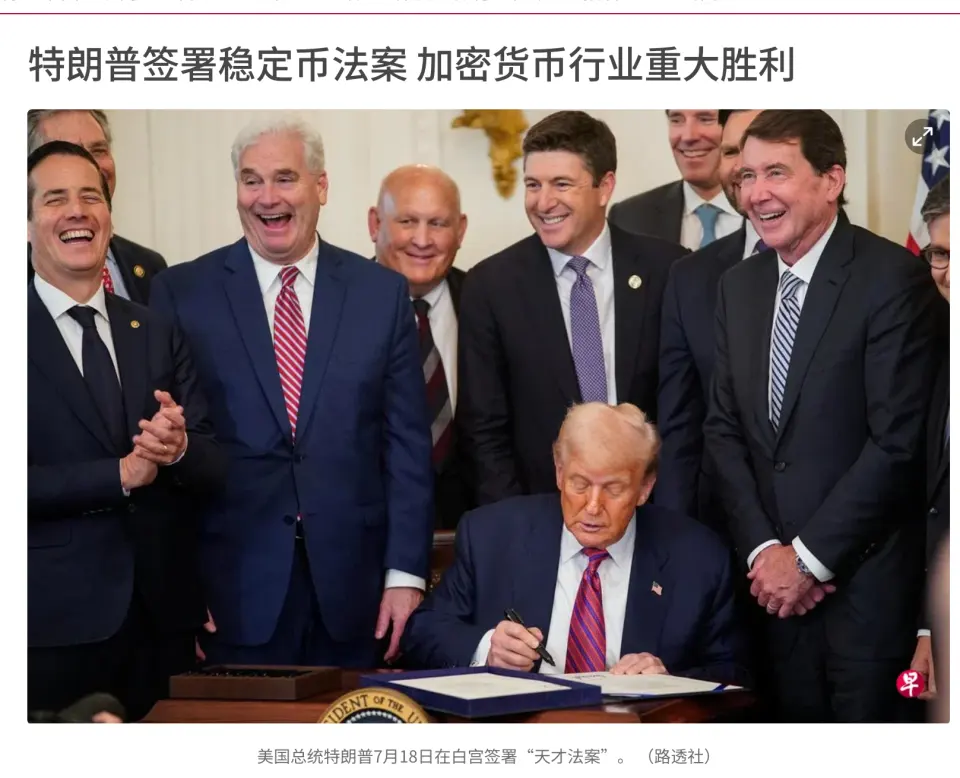
On July 18, 2025, Trump signed the GENIUS Act in the East Room of the White House, establishing a dedicated federal regulatory framework for payment stablecoins. Issuers must maintain fully qualified reserves, disclose the composition of those reserves, and fulfill anti-money laundering and other obligations.
Many people in the crypto world saw this as a victory: after all these years of struggle, the industry had finally been accepted by the mainstream market.
But in the end, that trust was misplaced.
The White House chose stablecoins in the hope that they would consolidate the international status of the US dollar, drive demand for US Treasury securities, and at the same time bring issuance and the flow of funds under regulation. The crypto industry produced a useful tool; the US government saw its value and adopted it to serve its own financial system.
The original ideals of the crypto world were not the starting point of this policy choice.
The US government is calculating in terms of the US dollar, and cross-border payment companies such as Stripe have their own calculations as well.
These emerging payment companies run internet businesses and want their services to be available at all times. Yet when it comes to cross-border flows of funds, what they rely on underneath is still banks and clearing systems. If a payment has to pass through several banks, each with its own processing times and reconciliation processes, and falls on a weekend or holiday, it still has to wait. However good the front-end product is, it is very difficult for a payment company to change this back-end process on its own.
Stablecoins allow the step of transmitting funds across borders to run on-chain around the clock. In July 2026, Stripe announced that it would provide stablecoin payment services to Ramp, a corporate spend management platform. Enterprises still pay supplier bills from bank accounts; Bridge, a Stripe subsidiary, converts US dollars into stablecoins and pays them into the recipient's wallet. Users do not even need to hold crypto first, so there is naturally no question of their first accepting the crypto world's decentralized notion that "if you own your private keys, you own your assets."
Banks that understand this pragmatic borrowing are naturally not averse to it either. At the end of September, Visa and Lloyds Bank of the United Kingdom announced a seven-day pilot totaling USD 750,000. Lloyds bought USD Coin (USDC) through a regulated trading institution and transferred it to Visa's US entity; the funds arrived within one hour, and settlement was completed on a weekend as well.
For the same payment obligation, settling earlier creates an opportunity to tie up less capital while waiting for settlement. After deducting conversion, custody and compliance costs, if the whole approach is more cost-effective, banks have reason to keep using it.
As for the monetary freedom the crypto world talks about, it is not important to the banks and payment institutions involved in this business.

It is not only payments and banking that have recognized the application potential and commercial value of encryption technology in finance; traditional stock markets have as well.
In October of this year, the Depository Trust Company (DTC), a subsidiary of the Depository Trust & Clearing Corporation (DTCC), launched a securities tokenization service, with 20 participating institutions signing on, including JPMorgan Chase and Citigroup. DTC converts eligible securities entitlements within its custody system into tokens, allowing them to be transferred on authorized chains and also converted back into traditional form. The securities remain in the original custody system, and holders' original rights and investor protections continue to be preserved.
It provides an additional way to use existing securities, without the need to first issue a project token to raise funds.
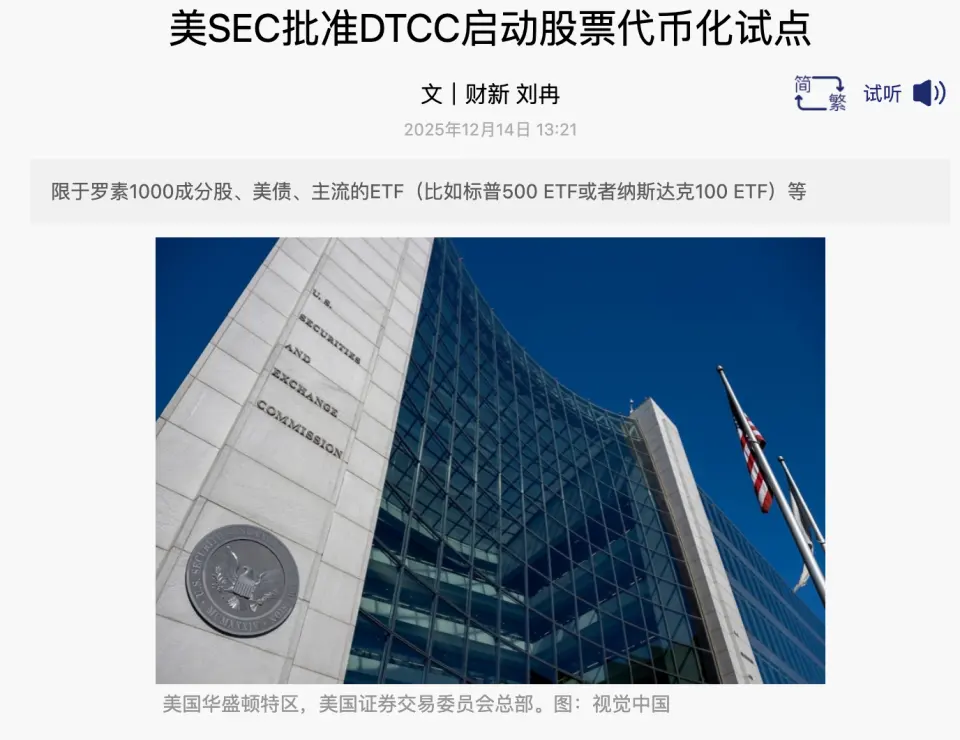
What institutions value is whether existing securities can circulate more promptly and be used as collateral, so that assets sit idle less; what they value is blockchain technology, while they may not necessarily think highly of, or feel confident in, the ready-made public chains of the crypto world.
The aforementioned DTCC used its own private network and the Canton network when the service launched. Tokens circulate only between wallets registered with DTC, and compliance controls are built in. Identity verification, anti-money laundering and regulatory cooperation that had to be done before still have to be done after going on-chain.
These institutions are entering with their own rules, and leading exchanges such as Binance and OKX are also actively moving closer to them.
In the old crypto world, exchanges were at the top of the food chain, controlling traffic and trading opportunities and enabling many wealth stories. But how many assets institutional clients are willing to bring to trade still depends on whether exchanges can accommodate their treasury management requirements.
For example, Binance's tri-party banking arrangement allows eligible institutional clients to keep collateral in corporate accounts at regulated banks while trading on the exchange. OKX's institutional solution with Standard Chartered Bank also places collateral in the custody of an independent bank outside the exchange. To win institutional orders, exchanges have integrated bank custody into their products.
All of this is very different from how the crypto world previously operated.
In the early days, projects relied on token issuance and crowdfunding, promising a permissionless internet where users control their own data and assets, while participants expected tokens to appreciate; the businesses now before us can already stand without that narrative.
Technology has been applied to finance, and the old crypto world's business model of relying on token issuance, exchange listings and waiting for newcomers to take over is unlikely to represent this industry any longer.
I prefer to call it "new crypto finance": traditional financial companies using encryption technology to solve problems in payments, settlement and asset circulation,survival of the fittestcrypto-native companies have also come to serve these needs.
This approach could not be more centralized.
I remain optimistic about this industry
Before writing this article, I first recorded a short video discussing these views.
Unexpectedly, quite a few friends in the comments understood it as the bear-market pessimism that is common in such periods; after all, whenever times like these arrive, there are always people saying the crypto market is coming to an end.
I can understand this reaction, but these friends clearly did not quite grasp what I meant.
My position has always been clear: Ihave consistentlybeen bullish on Bitcoin (BTC), and I am also optimistic about blockchain technology'sin the next-generation internetapplications.
Irejectthe idea of treating overnight wealth as the industry's long-term way forward, or believing that insisting on absolute decentralization alone will win users and the market.
Those who do not think about the distant future will surely have near-term worries. I made this short video and wrote this article to exchange views and discuss with partners who have long been deeply engaged in this industry.
In the past, one could first raise funds through tokens and subsidize users, then wait for the token price to help cover expenses; what about the future? Those who still want to work in this industry will next need to find clients who are willing to pay over the long term.
Over the past few months, my partners at Mankun Law Firm and I have often discussed similar topics. In recent years, Mankun Law Firm has been deeply rooted in the blockchain industry. From decentralized finance (DeFi), blockchain games (GameFi), social finance (SocialFi) and non-fungible token (NFT) projects to applications such as Bitcoin Layer 2 networks and decentralized exchanges (DEX), we have worked with teams across different tracks and provided them with legal and compliance support to the best of our ability.
This work has given us firsthand experience of the industry's ups and downs, and has also helped us better understand and recognize partners who are willing to work for the long term. In discussing crypto's new finance today, I hope that the technology, experience and trust between people accumulated over these years can continue to be applied to the industry's longer-term development.

Among the clients we have served in the past, we have clearly felt that Web3 users and markets are inherently global. A project's team, users and funds may be distributed across different countries and regions, and legal and compliance issues will therefore span different jurisdictions. To truly serve these clients over the long term, one cannot be familiar only with the rules of one place.
Therefore, we first established the development strategy of "China depth, global breadth," and then, around this goal, successively set up a presence in Shanghai, Shenzhen, Hong Kong and Silicon Valley. We both understand the circumstances of Chinese entrepreneurs and can provide support in the markets where they conduct business. Rather than always looking for opportunities in gray areas and chaos, I would rather see this industry come onto the stage and serve real clients under clear rules.
If one always wants to cling to one's own small patch of the crypto world and hopes that the next person will come in and buy coins to turn this market into a zero-sum game, that actually underestimates this industry.
We are glad to see stablecoins genuinely being used for payments in more and more countries and regions, to see asset tokenization beginning to enter the business of financial institutions, and to see on-chain finance rise again as more and more institutions enter. We also look forward to a future in which blockchain technology can be used in the trading and settlement of stocks.
Mankun Law Firm is also willing to continue walking alongside friends who are moving toward crypto's new finance.

