
In the second quarter of 2026, Netflix disclosed a figure in its letter to shareholders: over the course of the year, approximately 300 productions used generative AI. Once the news broke, many people's first reaction was: if AI can make shows, who owns the copyright in these productions?
Netflix itself did not overstate the position. In its production rules for partners, it drew a line: any use of AI involving the final cut, actors' likenesses, personal information, or third-party materials must go through enhanced review and obtain written approval before proceeding. In other words, the use of AI at scale is real, but copyright and liability are not automatically clarified merely because AI was used.
The question in the title can be answered in one sentence: copyright recognizes what a person did, not what AI drew. But this is only the first gate that AI film and television must pass through. Netflix's several hundred productions must pass through five gates in total. We will address them one by one.
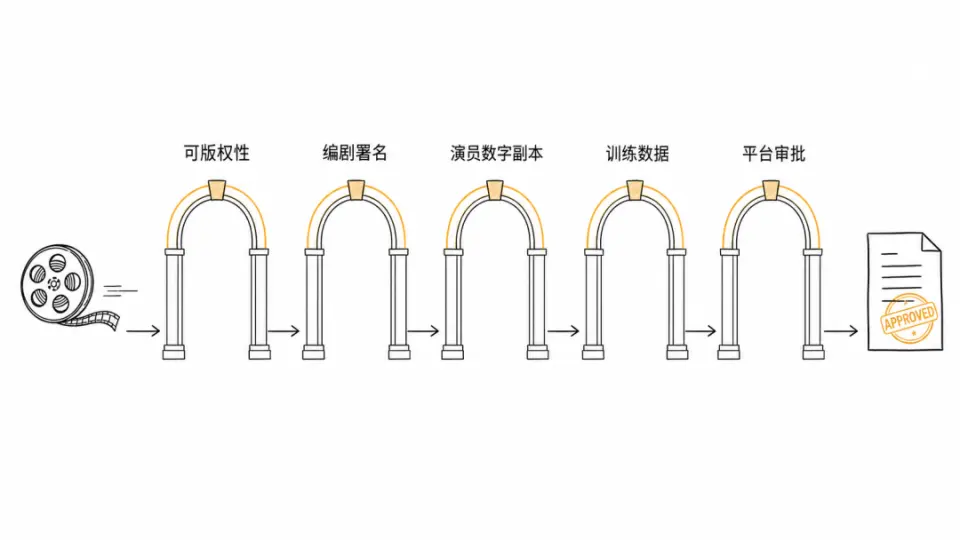
The Five Gates
The First Gate: Can This Production Obtain Copyright?
Let us be clear from the outset: copyright is never granted for "the part drawn by AI"; it is granted for "what a person did."
The threshold at the U.S. Copyright Office is just four words: human authorship. If something is generated entirely automatically by AI, with virtually no human involvement, it remains outside the door, and no one can register it. But as long as a person has genuinely taken action—selecting, arranging, and making creative modifications to AI's semi-finished output—the work as a whole can still obtain copyright.
In the vast majority of Netflix's 300 productions, AI was used in auxiliary stages such as post-production and visual effects. One example it disclosed is that approximately 17 minutes of footage in a certain production was enhanced with AI, doubling production speed and halving costs. Yet behind the final cut, the work of screenwriters, directors, editors, and actors was not reduced at all. The weight of human creation is sufficiently substantial; AI is merely a tool, and copyright naturally remains with the human.
The key to the Copyright Office's assessment is not whether you used AI, but whether you can genuinely control what it produces. You enter a prompt, and what it generates each time is different; the law does not recognize this kind of luck-based randomness. There is an old analogy: you sow a handful of seeds in a garden, and the final shape they grow into is not something you can determine; the law will not award you the entire patch of wildflowers merely because you sowed the seeds. The same applies to using AI: the prompt is like sowing seeds, the specific image is what AI "grows," and you have not genuinely "drawn" it.
Of course, this analogy is not entirely precise. The difference is that if you make extensive modifications and repeated refinements on the basis of AI output, re-selecting and recombining elements, that part is what you personally made and can be protected.
Two real registration cases best illustrate where the threshold lies. One person used AI to generate an image, entered prompts 624 times, and also post-processed it with software, yet the Copyright Office still refused: no matter how many prompts there are, they merely tell AI what you want; how the image is actually presented is determined by AI, and you have not formed "creative control." Another person made an AI-assisted image, revised it 35 times using the inpainting function, expanded the canvas, added elements, and also submitted a 9-minute-58-second video recording of the creation process; the Copyright Office registered it. What was registered was not the pixels AI filled in, but his selection, combination, and arrangement of those elements.
In one sentence: prompts alone are usually insufficient to make you the author.
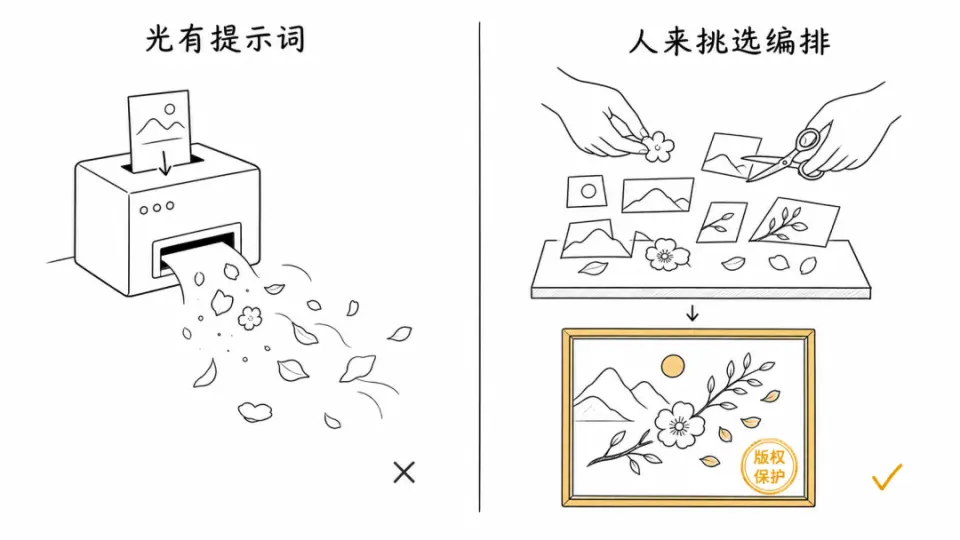
The boundary between purely AI-generated content and human creation
This threshold is clearly set out in the most authoritative U.S. precedent and in the Copyright Office's report.
Thaler v. Perlmutter, U.S. Court of Appeals for the District of Columbia Circuit, No. 23-5233 (March 18, 2025)
"Human authorship is a bedrock requirement of copyright."
Translation: Human authorship is a foundational requirement of copyright. (In that case, the applicant listed an AI system as the sole author of the work, and the Copyright Office refused registration; however, the court also made clear that this rule does not prohibit works "created by humans with the aid of AI" from obtaining protection.)
U.S. Copyright Office, Copyright and Artificial Intelligence, Part 2: Copyrightability report (January 2025)
Generative AI output may be protected by copyright only where a human author has determined sufficient expressive elements: this may be where the human-authored portion is perceptible in the AI output, or where the human has made a creative arrangement or modification of the output, but it cannot be merely the provision of prompts. Incorporating AI-generated material into a larger human-authored work does not prevent that work from obtaining copyright.
The second gate: screenwriter credit and compensation
This gate governs the people who write. The 2023 Hollywood writers' strike, which lasted 148 days of negotiations, produced a contract (the WGA 2023 MBA) that firmly settled several points on the relationship between AI and screenwriters.
AI is not a screenwriter. What AI writes does not count as "literary material," nor as "source material" that determines credit. The meaning of this provision is that even if a company hands a screenwriter an AI-generated first draft, the screenwriter is still regarded as the "first writer" of the project, and credit and compensation are unaffected. The company also has an obligation: if material provided to the screenwriter incorporates AI-generated content, it must disclose this truthfully. Conversely, the company may not compel a screenwriter to use AI.
Artificial intelligence provisions of the Writers Guild of America 2023 contract (WGA 2023 MBA)
"Neither traditional AI nor generative AI is a writer, so no written material produced by traditional AI or GAI can be considered literary material."
Translation: Neither traditional AI nor generative AI is a screenwriter, and therefore written material produced by AI cannot count as "literary material."
Ibid. (credit and compensation)
Where the AI-generated material provided by the company has not previously been published, "such material does not constitute assigned material (for purposes of calculating compensation) or source material (for purposes of determining attribution)," and the writer is therefore deemed the first author of the project.
Same as above (disclosure obligations and mandatory use)
"The Company must disclose to the writer if any materials given to the writer have been generated by AI or incorporate AI-generated material."
"…the company can't require the writer to use AI software (e.g., ChatGPT) when performing writing services."
Translation: The company must disclose to the writer whether the material provided to the writer is AI-generated or contains AI-generated components; the company may not require the writer to use AI software (such as ChatGPT) in performing writing services.
These rules govern Hollywood, but their logic holds for any company that uses AI to write things: AI can help you draft, but it does not take attribution, nor does it change who should be paid. If your company uses AI to write proposals or copy, it is best to clarify in advance who the "author" is and who bears responsibility.
The third gate: actors' faces and voices
This gate governs actors' faces and voices.
Today's AI can scan an actor's face, voice and performance characteristics and store them as data. Thereafter, the actor's performance can be "generated" without the actor being present. This data has a name: a digital replica.
Also under the contract negotiated in that strike, the Screen Actors Guild-American Federation of Television and Radio Artists (SAG-AFTRA) established three locks for digital replicas: to create a digital replica of an actor, the production must give the actor at least 48 hours' notice; it must obtain the actor's "clear and conspicuous" consent, which cannot be buried in a pile of standard-form terms and must be separately signed or initialed; and compensation must be paid. When the replica is used, the actor must also be given a "reasonably specific description" explaining where and how the replica will be used. A change of project or a change of use requires obtaining consent anew.
Netflix's own rules also track this provision: de-aging an actor, synthesizing a voice, or materially altering the emotion and intent of a performance are all listed among the matters requiring written consent.
SAG-AFTRA 2023 Film/Television Contract (digital replica provisions)
"48-hour advance notice prior to services for creation… Consent required… Must be clear and conspicuous… separately signed or initialed by the performer… Must include a reasonably specific description of the intended use."
Translation: Before a digital replica is created, 48 hours' notice must be given; consent must be obtained; the consent must be clear and conspicuous and separately signed or initialed by the actor; and it must be accompanied by a reasonably specific description of the intended use.
What actors' teams fear most is a "blanket authorization." A contract that vaguely states "authorized to use likeness," with no limit on term, scenario or number of uses, amounts to selling the face and voice outright in perpetuity, no different from signing an indenture. The prudent approach is one authorization per production, granting only one clearly defined use at a time.
There is a Chinese precedent for this as well. The Beijing Internet Court has decided a case involving the sale of goods using AI-synthesized voices, holding that as long as an ordinary person can recognize whose voice an AI-synthesized voice is, it falls within the scope of protection of voice rights and interests, and unauthorized use gives rise to liability. The yardstick is "identifiability": if it sounds enough like you to be recognized as you, then your voice has been used.
The fourth gate: whose material was the AI trained on?
This gate asks a question further upstream: whose material was this AI trained on?
Among the red lines Netflix draws for its partners is one: without lawful authorization, materials from artists, performers or other rights holders must not be used to train or fine-tune models. It also requires partners to go back and review the terms of the tools they use, to see whether the AI company will retain what you input and use it for further training.
Why is it regulated so strictly? Because problems at the training stage carry through all the way to the final cut. If an AI tool scraped unauthorized content during training, the images and music it generates may constitute "substantial similarity" to the original works. Once such a final cut is publicly released, the production company faces not only infringement claims from the original rights holders; in serious cases, the entire project's core copyright may be forced to be taken down due to defects in title, and all the upfront investment is lost. This liability is passed back and forth among the production company, the AI supplier and the delivery party through the warranties and indemnities in the contracts.
Netflix, "Use of Generative AI in Content Production" (partner rules, training data section)
"Do not train or fine-tune models using material from artists, performers, or other rights holders unless you have the proper legal clearance."
Translation: Unless appropriate lawful authorization has been obtained, materials from artists, performers or other rights holders must not be used to train or fine-tune models.
The fifth gate: the platform's own gate
This gate is one Netflix has set for itself. It lists five low-risk principles for partners; only if all five are satisfied may AI be used directly without additional approval.
Netflix, "Use of Generative AI in Content Production" (five low-risk principles)
1. The output will not copy or substantially reproduce the identifiable features of materials owned by others or protected by copyright;
2. The generative tools used will not store or reuse your production data inputs and outputs, nor use them for training;
III. Use in enterprise-grade security environments to protect input content;
IV. Generated materials are temporary and do not enter the final deliverables;
V. Do not use generative AI to replace or generate new performer performances, or work within the scope covered by the union, unless consent is obtained.
If even one question cannot be answered "yes," the review must be escalated and written approval obtained. This gate is not imposed by law; it is an insurance policy the platform has contractually put in place for itself and its partners. It fills precisely the gaps left by the preceding gates: details that law and unions cannot reach are caught by the platform's own rules and approval processes.
What the five gates, layered together, demonstrate
Putting these gates side by side makes one thing clear: what governs AI film and television has never been a single law or a single institution. The Copyright Office determines whether a work counts, the Writers Guild governs credit and compensation, the actors' union governs faces and voices, the cleanliness of training data is secured layer by layer through copyright law and contracts, and the platform itself establishes an additional approval gate. None can replace another.
This leads to the most practical judgment for AI content companies: a single statement from a model provider that "our data is all compliant" cannot replace your own item-by-item rights clearance. A broad written assurance is far less useful than a process that leaves an audit trail. When a dispute actually arises, the judge does not look at whom you believed, but at what you left on record.
Different people, different takeaways
Ordinary viewers: Most of the time you will not know whether a film you watch on Netflix used AI, and it does not much affect the viewing experience. What truly deserves attention is "synthetic performances": when a familiar actor appears in a scene he or she never performed, whether the "clear and conspicuous" consent exists behind it is the dividing line for whether that image is lawful.
Writers and actors: Remember two phrases. Writers, remember that "AI is not an author"; your credit and compensation should not shrink just because the company used AI. Actors, remember "one authorization per production"; do not sign authorizations that have no term, no scope of use, and no revenue share.
AI content entrepreneurs: This is the group with the heaviest exposure. If you are working on AI film and television, AI short dramas, or supplying tools and post-production for such projects, your contracts should break out at least seven groups of clauses and spell out each one clearly: authorization for training data, non-retention of inputs and outputs, records documenting human creative involvement, item-by-item consent from performers, disclosure of AI use, warranties of rights in the final deliverables, and who bears liability if infringement occurs. Not one of these seven groups can be omitted.
The reason these hundreds of Netflix AI works can obtain copyright is not that AI has become more capable, but that humans remain in the process. Copyright recognizes human creation; the union protects people's livelihoods. The platform's approval gate safeguards its own risk. AI has driven down production costs, yet none of these five gates has been removed; instead, because of scale, for the first time all of them are exposed on the same production line.
For those who want to make money on this line, rather than betting that the rules will loosen, it is better to take every gate seriously. Investing effort in record-keeping upfront is far cheaper than hiring a lawyer after something goes wrong.
If you are working on an AI content-related project and would like someone to review the contract side for you, feel free to get in touch.
Reference sources
- Netflix Q2 2026 shareholder letter (U.S. Securities and Exchange Commission filing, Exhibit 99.1)
- Variety: "About 300 Netflix Programs Have Used Generative AI This Year" (2026)
- IndieWire:《Netflix Co-CEO Explains How Gen-AI Was Used in 300 Different Titles》
- Netflix partner production rules: "Using Generative AI in Content Production" (Netflix Partner Help)
- U.S. Copyright Office, "Copyright and Artificial Intelligence, Part 2: Copyrightability" report (January 2025)
- U.S. Copyright Office, Copyright Registration Guidance for Works Containing AI-Generated Materials (37 CFR Part 202)
- Thaler v. Perlmutter, U.S. Court of Appeals for the District of Columbia Circuit, No. 23-5233 (130 F.4th 1039, March 18, 2025)
- AI Provisions of the Writers Guild of America 2023 Basic Agreement (WGA 2023 MBA)
- Digital Replica Provisions of the Screen Actors Guild 2023 Film/Television Contract (SAG-AFTRA)
Author:Lü Yinghui, a lawyer at Mankun (Shenzhen) Law Firm. A graduate of China University of Political Science and Law, with nearly a decade of deep experience in the legal industry, having previously worked at a court in Shenzhen. Focused on legal services in the new-generation economy, with extensive practical experience and deep insights in fields such as Web3 and artificial intelligence. Account across all platforms: Lao Lü Talks New Money; you are welcome to follow.

