
Over the past year, 97 companies have entered the embodied intelligence data collection sector, raising RMB 4.47 billion. On the other side of the boom, the first compliance penalty has already been issued. This article does not discuss how this business makes money; it addresses one thing only: where the three main pathways for robot training data—collection, resale and scraping—each intersect with the provisions of the Personal Information Protection Law, and how to proceed without crossing those lines.
In Chenzhou, Hunan, a China Mobile business hall has put up a sign reading "Embodied Data Collection 5S Store." Ordinary customers receive a set of grippers, gloves and a head-mounted camera; after brief training, they can collect robot training data while doing household chores. The first phase deploys 1,000 sets of equipment, and at full capacity 1 million hours can be collected per year.
Such novel approaches are now everywhere. Some companies offer free home cleaning in order to get into your home to collect data; some turn collection into a VR game; others have collectors perform remote "cloud operation." QbitAI counted 97 embodied data players in China—70 doing collection and 27 doing data infrastructure. Over the past year, that is, from July 2025 to July 2026, this sector raised approximately RMB 4.47 billion, and 64 data collection centers were built nationwide.
On the other side of the boom is a penalty issued in September 2025. During the "Guard the Network 2025" special campaign, a computing-material company mainly engaged in "providing basic data for external artificial intelligence model training" was administratively penalized and ordered to rectify by the local public security organ. The reason was specific: before processing biometric information such as faces, it had not conducted a personal information protection impact assessment as required by the Personal Information Protection Law.
This is the first clearly priced compliance penalty in the embodied data sector. And today, July 15, 2026, the Interim Measures for the Administration of AI Anthropomorphic Interactive Services, jointly issued by the Cyberspace Administration of China and four other departments, officially took effect, marking the first time that the management of AI training data has dedicated regulations.
The volume of data collection is surging more than tenfold each year, yet the compliance foundation has not yet been laid. The following three lines are the easiest to cross.
First, let us be clear about why robot learning of household chores cannot avoid the Personal Information Protection Law
Let us walk through the chain first. A collector puts on a head-mounted camera and sensor gloves and folds clothes, wipes tables and opens the refrigerator at home. The camera records images, the gloves record movements, and this data is packaged and sold to robot companies to train the model's hand-eye coordination.
The problem lies in the "recording images" step. Faces, hands and the appearance of the home captured by the lens, so long as they can be linked to a specific individual, are personal information in law. Article 4 of the Personal Information Protection Law states plainly: personal information means various information recorded electronically or by other means that relates to an identified or identifiable natural person, excluding information after anonymization. A home video in which a person can be recognized falls squarely within this definition.
And faces are not ordinary personal information; they are sensitive personal information.
Article 28 of the Personal Information Protection Law: Sensitive personal information means personal information that, once leaked or illegally used, is likely to cause harm to the personal dignity of a natural person or endanger the safety of his or her person or property, including biometric, religious belief, specific identity, medical health, financial account, whereabouts and other information, as well as the personal information of minors under the age of fourteen.
Personal information processors may process sensitive personal information only where there is a specific purpose and sufficient necessity and where strict protective measures are taken.
Once personal information is involved, its processing requires a legal "entry ticket." Article 13 of the Personal Information Protection Law lists seven such grounds; in the context of data collection, only the first is realistically available: obtaining the individual's consent.
Article 13 of the Personal Information Protection Law: A personal information processor may process personal information only under any one of the following circumstances:
(1) the individual's consent has been obtained;
(2) the processing is necessary for the conclusion or performance of a contract to which the individual is a party, or for the implementation of human resources management in accordance with labor rules and regulations formulated in accordance with the law and collective contracts concluded in accordance with the law;
(3) the processing is necessary for the performance of statutory duties or statutory obligations;
(4) the processing is necessary to respond to public health emergencies, or, in emergency situations, to protect the life, health and property safety of natural persons;
(5) the processing of personal information is within a reasonable scope for news reporting, public opinion supervision and other acts carried out in the public interest;
(6) personal information that the individual has made public by themselves or other personal information that has been lawfully made public is processed within a reasonable scope in accordance with the provisions of this Law;
(7) other circumstances provided for by laws and administrative regulations.
Where the processing of personal information is subject to other relevant provisions of this Law, the individual's consent shall be obtained; however, consent need not be obtained where any of the circumstances specified in Items 2 to 7 of the preceding paragraph applies.
There is also a specific rule for AI training. Article 7 of the Interim Measures for the Administration of Generative Artificial Intelligence Services, which took effect in 2023, sets out the threshold for training data clearly.
Article 7 of the Interim Measures for the Administration of Generative Artificial Intelligence Services: Providers of generative artificial intelligence services (hereinafter referred to as providers) shall carry out pre-training, optimization training and other training data processing activities in accordance with the law and comply with the following provisions:
(1) Use data and foundation models from lawful sources;
(2) Where intellectual property rights are involved, the intellectual property rights lawfully enjoyed by others shall not be infringed;
(3) Where personal information is involved, the consent of the individual shall be obtained, or other circumstances prescribed by laws and administrative regulations shall be met;
(4) Take effective measures to improve the quality of training data and enhance the authenticity, accuracy, objectivity and diversity of training data;
(5) Other relevant provisions of the Cybersecurity Law of the People's Republic of China, the Data Security Law of the People's Republic of China, the Personal Information Protection Law of the People's Republic of China and other laws and administrative regulations, as well as the relevant regulatory requirements of the competent authorities.
In one sentence: if training data contains human faces, there is no way around the two hurdles of "lawful source" and "obtaining consent." The three issues in dispute that follow all revolve around these two hurdles.
The faces captured by the head-mounted camera: do they belong to the collector, or to your child?
The collector gathers data in their own home and has signed a consent form, which appears to present no problem. But the field of view of a head-mounted camera cannot be controlled. As soon as the collector turns their head, the lens sweeps across the child doing homework in the living room, the neighbor dropping by, and the elderly person sitting on the sofa.
These people have not signed anything.
The collector's consent can only cover the collector themselvesWhen the faces of co-residents, visitors and children are captured, this constitutes processing the sensitive personal information of these persons, and their consent must be obtained separately. Moreover, it is not enough to casually click "I agree"; human faces are sensitive personal information, and the law requires separate consent.
Article 29 of the Personal Information Protection Law: To process sensitive personal information, the consent of the individual shall be obtained separately; where laws or administrative regulations provide that written consent shall be obtained for the processing of sensitive personal information, such provisions shall prevail.
"Separate consent" means that the facial recognition item cannot be slipped into an all-encompassing user agreement to muddle through; it must be carved out and authorized separately. Bundling the faces of co-residents into the collector's general agreement is tantamount to not having obtained consent.
If children under the age of fourteen appear in the footage, a further layer is required. A child's personal information is itself sensitive personal information, and its processing also requires the consent of a guardian.
Article 31 of the Personal Information Protection Law: Where a personal information processor processes the personal information of minors under the age of fourteen, it shall obtain the consent of the minors' parents or other guardians.
A personal information processor that processes the personal information of minors under the age of fourteen shall formulate dedicated personal information processing rules.
Article 17 of the Measures for Anthropomorphic Interactive Services, which takes effect today, reiterates this requirement and adds a compliance audit.
Article 17 of the Interim Measures for the Administration of Artificial Intelligence Anthropomorphic Interactive Services: Where the personal information of minors under the age of fourteen is processed, the consent of the minors' parents or other guardians shall be obtained.
A compliance audit of its processing of minors' personal information in compliance with laws and administrative regulations shall be conducted in accordance with relevant national provisions, either on its own or by engaging a professional institution.
There is one more step that many companies simply skip: before processing sensitive information such as facial data, a personal information protection impact assessment, commonly known as a PIA, must first be conducted. The penalty in the 2025 cyber defense operation was imposed precisely for this step.
Article 55 of the Personal Information Protection Law: In any of the following circumstances, a personal information processor shall conduct a personal information protection impact assessment in advance and keep records of the processing:
(1) processing sensitive personal information;
(2) using personal information for automated decision-making;
(3) entrusting the processing of personal information, providing personal information to other personal information processors, or publicly disclosing personal information;
(4) providing personal information to overseas recipients;
(5) other personal information processing activities that have a material impact on the rights and interests of individuals.
This step is not a mere formality. The law requires that assessment reports and processing records be retained for at least three years; when regulators come knocking, these are your evidence of compliance. What that data-processing company lacked was precisely this assessment. It did nothing else wrong; it was simply missing one procedural link, and the penalty notice followed.
So for the in-home data collection line, the real compliance action is to broaden the scope of authorization: not just the collectors, but everyone who might appear on camera; where children are involved, either obtain a guardian's signature or mask the children's faces before the data leaves the system. If that cannot be done, this data is problematic from the source.
Selling one dataset to three companies: can consent travel with the data?
The most attractive aspect of embodied data is that the same dataset can be sold repeatedly. One company has publicized a model with a "10x resale rate": a dataset is sold to robot company A, then to B, then to systems integrator C, with marginal costs near zero.
But consent does not automatically travel with the data.。
Article 23 of the Personal Information Protection Law governs precisely this. When you provide personal information in your possession to another company, it is not enough to simply package it up and send it over; you must first tell the individual "to whom I will provide it and what the recipient will use it for," and you must also obtain separate consent.
Article 23 of the Personal Information Protection Law: Where a personal information processor provides personal information it processes to another personal information processor, it shall inform the individual of the name or title and contact information of the recipient, the purpose and method of processing, and the categories of personal information, and shall obtain the individual's separate consent. The recipient shall process the personal information within the scope of the aforementioned purpose and method of processing and categories of personal information. Where the recipient changes the original purpose or method of processing, it shall obtain the individual's consent anew in accordance with this Law.
Broken down, this article is almost fatal to resale. First, each further sale down the chain requires separate notice and separate consent anew; second, the recipient may use the data only within the originally agreed purpose, and any change of use requires going back to obtain consent anew. As data circulates among A, B, and C, the consent chain must be supplemented at each turn. Whichever link in the chain breaks, the risk falls on that link.
The most common self-reassurance here is: "I have anonymized it, so it is no longer governed by the Personal Information Protection Law." That is only half right. True anonymization means that after processing, it is impossible to re-identify a specific individual and impossible to restore. But faces, body posture, and home environments are precisely the things used to identify people, and it is very difficult to make them non-restorable. If de-identification or masking has been applied but the data can still be restored technically, then in law it remains personal information, and not one step of the required consent can be skipped. Article 4 of the Personal Information Protection Law draws this line clearly: only information after anonymization processing does not count as personal information.
So the compliance actions for the resale line are: when data leaves the system, supplement a data processing agreement that fixes in writing the recipient, the purpose, and the categories; the consent form at the source must from the outset cover "may be provided to third parties for robot training"; and each provision to a third party requires a impact assessment under Article 55. If that is too troublesome, then do not treat resale as a zero-cost business: each additional sale adds another obligation of notice and consent.
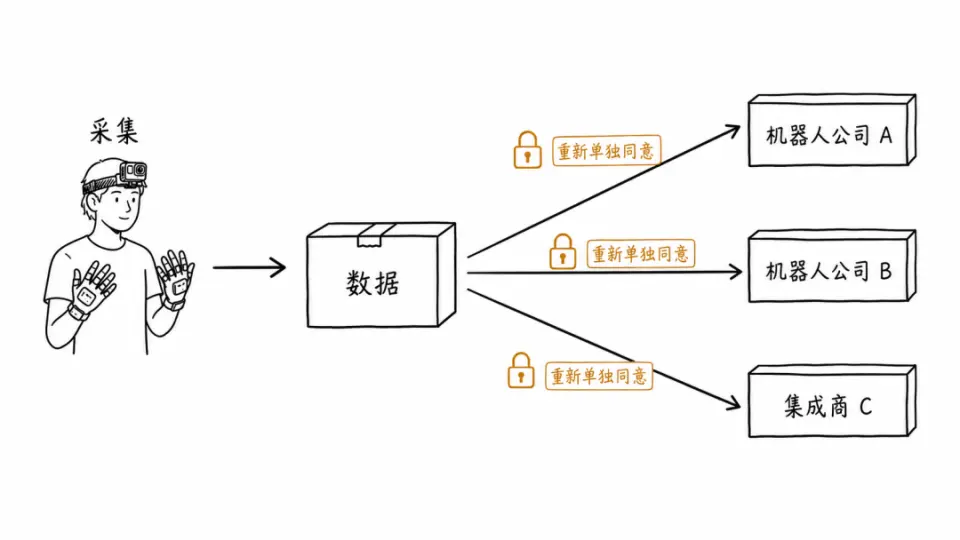
Every time the data is resold, consent must be obtained again
Scraping videos from Bilibili and Douyin for "distillation": is this a compliance shortcut?
Data collection is too expensive, so some have taken another path: directly scraping public videos from Bilibili, Douyin and YouTube, and "distilling" human movements into data that robots can learn from. Some companies claim that this path can reduce costs to five-thousandths of the industry level.
The temptation is great, and so is the misconception. The most commonly heard line is: "The videos are all public, so what's wrong with using them however I like?"
Public does not mean free to use however one likesArticle 27 of the Personal Information Protection Law leaves an opening for "publicly disclosed information," but that opening has limits.
Article 27 of the Personal Information Protection Law: A personal information processor may, within a reasonable scope, process personal information that an individual has disclosed by themselves or that has otherwise been lawfully disclosed, except where the individual has expressly refused. Where a personal information processor processes publicly disclosed personal information and such processing has a major impact on the rights and interests of the individual, the processor shall obtain the individual's consent in accordance with this Law.
Two limiting phrases are key. One is "within a reasonable scope"; the other is "where it has a major impact on the rights and interests of the individual, consent must still be obtained." A cooking video posted by a blogger themselves, showing his clearly identifiable face, voice and hand movements, which you scrape and feed into commercial model training, has long exceeded the reasonable scope of his original purpose of "showing it to fans"; and what is being processed is sensitive information such as facial images, so the impact on the individual's rights and interests cannot be said to be anything but major. Once these two points are combined, the shield of "already public" basically does not hold up, and one must still return to the old path of obtaining consent.
There is a further layer above this, namely the "lawful source" referred to in Article 7, paragraph 1, of the Generative AI Measures. Platform videos are subject to the platform's user agreement and the creator's copyright; bypassing these to conduct bulk scraping casts doubt on the source itself. This layer will not be elaborated here, but it genuinely exists.
So is this path completely blocked? Not entirely. The boundary is actually clear: where there is no identifiable natural person in the footage, such as pure scenery, pure object manipulation, or purely synthetically generated videos, an exemption may apply; once there is a recognizable face or human voice, the proportion must be assessed frame by frame, filtering or masking must be carried out, and source evidence must be retained. Scraping everything indiscriminately to save effort is the most aggressive and also the most precarious gray area in the entire sector today.
Where regulation is heading, and a checklist you can follow
Straightening out the timeline makes the direction of regulation easy to see. In September 2025, the Cyber Shield operation issued the first AI training-data penalty; in the same batch, the Cyberspace Administration's notices of typical cases included both a vending machine warned for collecting faces without consent and an AI face-swap taken down for failing to conduct a security assessment. On July 9, 2026, the Central Cyberspace Affairs Commission, the Ministry of Industry and Information Technology and the Ministry of Public Security jointly notified 72 Apps that illegally collected personal information. Today, the Measures for Anthropomorphic Interactive Services take effect. The signal is already very clear: compliance in AI training data is shifting from nobody regulating it to being a priority for regulation.
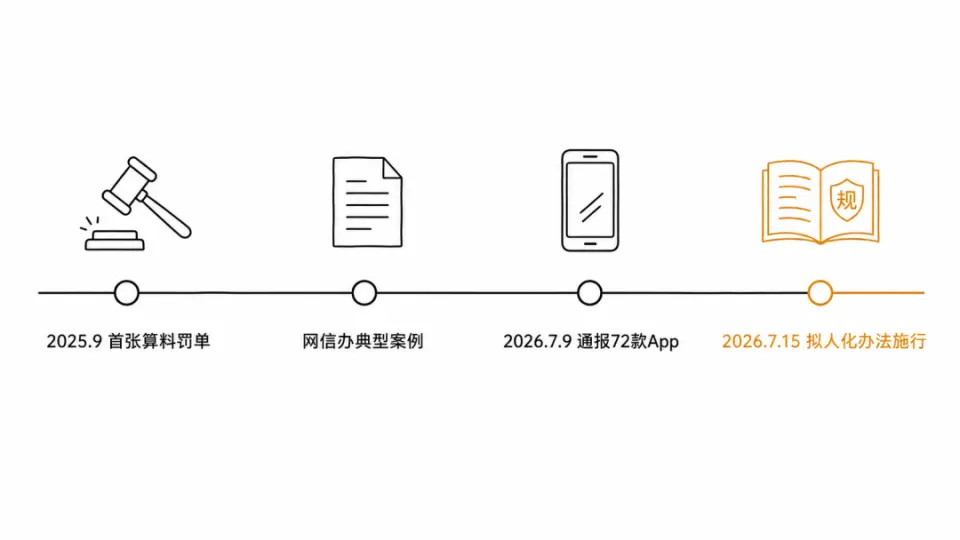
Timeline of AI Training Data Regulation
A paper from Shanghai University of Finance and Economics on privacy governance for embodied data identifies three real problems currently facing this industry. In plain terms: the impact assessments that should be conducted before collection are generally not conducted, that is, there is an absence of PIAs; once data is fed into a model, it cannot be cleanly deleted even if deletion is desired, and the right to deletion granted by law becomes an empty letter; and when something goes wrong, it is basically impossible to get a company to explain how the algorithm used your data. These three points happen to correspond to the soft spots in the three disputes discussed above.
If you are engaged in this business, the following four things can be changed immediately.
First, for in-home collection, expand the scope of authorization from the collector alone to all co-residents who may be captured on camera; where children under fourteen appear on camera, choose between guardian consent and masking, and do not gamble.
Second, for external provision of data, whether by sale or resale, complete the data processing agreement, state in the source consent form that the data "may be provided to third parties for robot training," conduct an impact assessment before each external provision, and retain it on file for three years.
Third, for internet video distillation, assess frame by frame the proportion of identifiable natural persons, design filtering and masking processes, retain evidence of the lawful source of every piece of data, and do not treat "public" as a reason for free use.
Fourth, keep records throughout the entire process. From the moment of collection, record collection activity logs and data flow logs, and where conditions permit, store evidence on-chain. The right to deletion must have a technical fallback; even if complete erasure from the model is impossible, at least be able to prove that you made every effort.
RMB 4.47 billion has already been invested, 64 collection centers have already been built, and data is still accumulating at a rate of more than tenfold each year. What truly determines who can laugh last may not be who collects more and sells faster, but whether every frame of whose data can produce that statement: "this is a lawful source." This question has already been tested for everyone for the first time by HW 2025.

