In a due diligence review by a bank or institutional client, a crypto payment platform may present its U.S. MSB registration certificate and explain that it has established KYC(), transaction monitoring and anti-money laundering systems. For an early-stage project still testing its product, this set of materials may already be sufficient to explain the enterprise's basic compliance status; however, once the platform begins serving users in different countries, connecting fiat currency accounts, bank cards and merchant settlement, and further offering exchange, custody, yield or lending functions, the other party's questions will quickly go beyond the scope of "a single license."
The bank will continue to ask: which entity undertakes the money transmission for U.S. users, which company European clients contract with, who owns the wallets controlled by the platform, which payment institution handles fiat settlement, how user assets are segregated from the group's own funds, and which entity provides the yield-type products.
At this stage, the project team often truly realizes thata single license can prove that a certain entity has a portion of regulatory status, but it is difficult for it to simultaneously cover multiple countries, multiple products and an entire funds chain.What the enterprise ultimately adds is not merely the number of licenses, but the division of roles among entities, contractual relationships, funds pathways and regulatory responsibilities. This is the real reason why multi-license coordination arises.
Multi-license coordination is not an enterprise constantly "collecting stamps" in order to appear more compliant; rather, it is a structural inevitability that emerges when crypto payments enter the real financial system and move toward scale.
Once crypto payments grow large, they are no longer merely a payment tool
In the early days of the industry, crypto payments were often understood as several relatively independent product functions, such as users using stablecoins to make purchases, buying crypto assets through bank cards, or transferring digital assets in a wallet()to another address. At this stage, projects cared most about payment speed, fees, user growth and product experience; one company, one basic license and a relatively simple funds pathway were usually enough to support early testing.
However, as the business grows, platforms often gradually evolve from a single payment entry point into an account-based financial product. Users may not only make payments, but may also top up, safekeep and exchange assets within the platform, apply for virtual or physical cards, transfer funds to other users, receive fiat remittances, obtain yield, and even obtain lending services based on digital assets.
From the user interface perspective, these functions may still be concentrated in the same account; but from a regulatory perspective, they already involve businesses of different natures, such as payment execution, money transmission, merchant acquiring, virtual asset exchange, client asset custody, lending and investment yield.
This is also where a single license first fails.FinCEN MSB registration and state-level MTLs in the United States() address federal anti-money laundering status and state-level money transmission licensing respectively; the EU's MiCA establishes unified rules for the crypto asset market, but fiat payments may still require corresponding statuses such as PI or EMI; Singapore's Payment Services Act regulates by specific functions such as domestic money transfer, cross-border money transfer, merchant acquisition and digital payment token services; Hong Kong's centralized virtual asset trading platforms are subject to the SFC() 's VATP licensing regime. Different jurisdictions are increasing their level of coordination, but there is no single global license that automatically covers all regions and all payment functions.
Therefore, when crypto payments evolve from a product feature into a financial platform that simultaneously connects accounts, wallets, banks, card networks and merchants, the regulatory structure will inevitably expand accordingly.
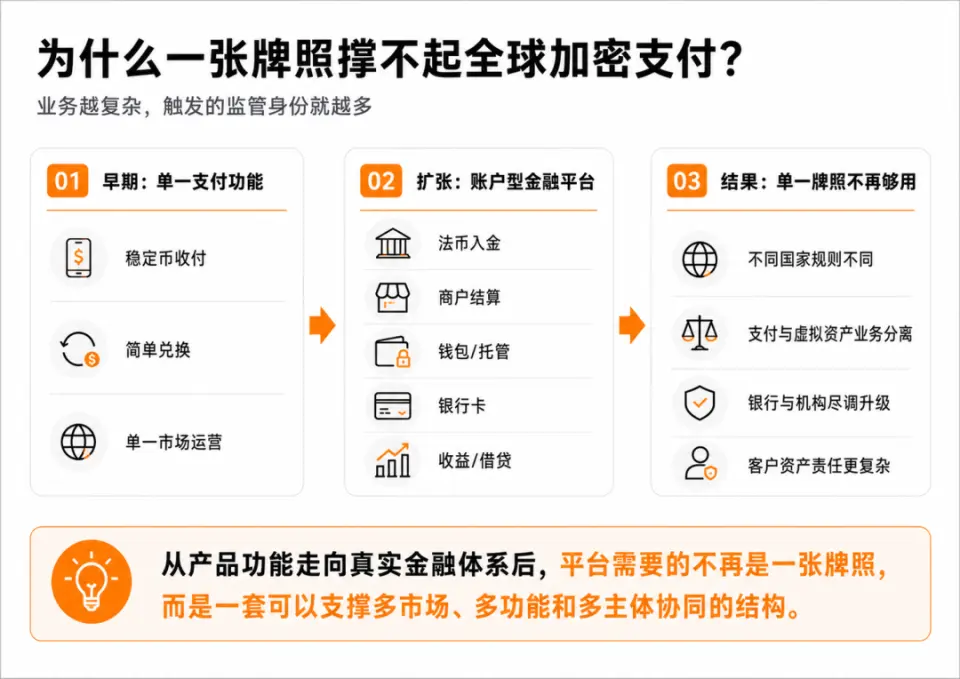
Figure 1 | Why can't a single license support global crypto payments?
Multi-license coordination: what is truly coordinated is a three-layer structure
The industry often understands multi-license coordination as "applying for more licenses in more countries," but a truly mature structure is not simply stacking all licenses under the name of one company; rather, it is layered according to business functions, target markets and risk responsibilities.
The first layer is functional layering. Fiat collection and payment, merchant settlement and bank card payments usually need to be undertaken by entities such as payment institutions, money transmission institutions or banks; stablecoin()exchange, virtual asset transfer and client asset custody may be undertaken by VASPs, CASPs, DPT service providers or other licensed digital asset entities. If the platform also provides yield, lending or investment-related services, these modules usually require further assessment as to whether they should be operated by separate entities.
The second layer is regional layering. A platform may use a unified brand, unified technical interfaces and a similar user experience, but customer contracts, fund receipt and regulatory responsibilities in different regions often need to be undertaken by local entities. European business may be undertaken by an EU PI, EMI or CASP; U.S. business needs to combine MSB and state MTLs; and Japan, Hong Kong, Singapore and other markets also need to be designed separately according to local regulatory rules.
The third layer is risk layering. By having different entities undertake different businesses, an enterprise can more clearly delineate client asset responsibilities, anti-money laundering responsibilities, product responsibilities and regulatory reporting obligations. When regulatory policies, cooperation channels or product modules in a certain region change, the project does not need to expose all businesses of the entire group to the same risk at the same time.
Genuine multi-licence coordination is not about “obtaining a few more licences”; it is about ensuring that the right business is conducted by the right entity in the right market.

Figure 2 | Functional, regional and risk layering in multi-licence coordination
When should a project begin to consider multi-licence coordination?
Multi-licence planning does not mean that a start-up should apply for multiple heavyweight licences across several countries all at once before its product launches. For projects that are still validating user demand and their business model, building a complex group structure too early not only increases costs but may also require the team to maintain regulatory statuses over the long term that are not genuinely used.
However, once a project begins to enter a second major market and users in different regions are already generating real transactions; once a product involves both stablecoins and fiat currency and requires access to bank accounts, payment channels, bank cards or merchant settlement; once a platform begins to control customer wallets, manage user balances, or add yield, lending and custody functions; or once banks, card issuers and institutional clients have begun to require the project to provide a complete explanation of its group structure, fund flows and licence coverage, an enterprise should no longer understand compliance as a question of whether “an existing licence can continue to suffice”.
At that point, what needs to be initiated is not a blind licence application but a round of structural diagnosis: which businesses must be undertaken by its own licensed entities, which steps can be completed by banks, payment institutions, custodians or other partners, which regions should have services restricted at the current stage, and how the group’s entities should contract, settle and allocate responsibility among themselves.
What is genuinely dangerous is not that a project temporarily lacks licences covering all markets, but that its business has already crossed multiple regulatory boundaries while a single entity still bears all contractual, fund and product responsibility.
Multi-licence coordination also does not mean that all licences must be held by the project itself
When designing a global structure, a project can generally combine its own licences, licensed partnerships and restricted markets. Core markets, core products and the key fund-related steps that determine customer experience can gradually be undertaken by the group’s own licensed entities; in regions with smaller transaction volumes or where testing is still ongoing, compliant channels may be used within the scope of a partner’s licence, with clarity on the fund and asset functions that the platform itself does not undertake.
However, “using a licensed partner” must not be understood as simply borrowing a licence. A project must confirm whether the partner institution genuinely receives and controls customer funds, whether its permitted scope covers the relevant products and service regions, who signs the customer contracts, and who bears responsibility in the event of refunds, account freezes, suspicious transactions or regulatory inquiries. If the core fund-related steps remain under the project’s actual control and a licensed institution is connected only at the final step, the partner’s licence may not cover the business that the project itself has already conducted.
Therefore, the most important aspect of multi-licence coordination is not the total number of licences, but whether the entities, licences, contracts and fund flows are consistent.
What can Mankun deliver for a project?
What a crypto payment project truly needs is usually not a table listing the names of licenses in every country, but a structural plan that can explain "who bears the existing business, where the gaps are, and how to implement the next steps."
First, Mankun can conduct a global business diagnosis centered on the project's existing products, customer regions, group entities, wallet control methods, and fiat settlement pathways, and produce a Product Function and Regulatory Identity Matrix, a Global License Coverage and Gap Analysis, and a Multi-Entity Function Allocation Plan. Through this stage, the project can clarify which businesses constitute payment, money transmission, exchange, custody, or other financial services, which functions are already covered by licenses, and which still rely on partners or present regulatory gaps.
Second, Mankun can design, based on actual transaction flows, the structure among the holding entity, the digital asset service entity, the local payment entity, and channel partners, and produce a Global Entity Structure Chart, an On-Chain and Off-Chain Fund Flow Chart, a Group Function and Regulatory Responsibility Matrix, and a customer asset segregation plan. The relevant deliverables are not only for internal decision-making but can also directly serve bank account opening, card issuance cooperation, payment channel access, and investor due diligence.
Finally, Mankun can formulate a Short-, Medium-, and Long-Term License Roadmap based on the project's business stage, clarifying which markets should be prioritized for applications, which businesses are suitable to be conducted through licensed partners, and which products and contracts need to be adjusted before applying for licenses. At the same time, in connection with institutional cooperation, Mankun can further prepare a Bank and Payment Channel Due Diligence Materials Package, a Licensed Partner Coverage Analysis, AML/KYC/KYT Policy Documents, and a continuing compliance budget, ensuring that the license structure can genuinely support business operations rather than remaining in organizational charts and promotional materials.
What Mankun delivers is not advice to "apply for a few more licenses," but a global compliance architecture that aligns products, funds, entities, and regulatory responsibilities with one another.
Conclusion: PayFi competition is shifting from product competition to structural competition
Looking back at the development of the crypto payment industry over the past few years, an increasingly clear path can be seen: early projects launched quickly with simple entities and basic licenses; as product functions increased, customer regions expanded, and fund scale grew, the original structures gradually could no longer explain the actual business, and ultimately the entities, licenses, and fund pathways had to be reconfigured.
This change is not the compliance department proactively making the business more complex; rather, the global payment system itself is composed of different countries, different account networks, and different financial licenses. Once crypto payments attempt to connect to this system, they must accept the territorial and functional nature of regulatory boundaries.
A truly mature multi-license structure does not treat the number of licenses as a competitive advantage; rather, it lets customers know which entity they are transacting with, lets banks know why funds are entering a given account, lets regulators know which company bears which responsibility, and enables the group to maintain the stability of its overall business when risks arise in a particular market or product.
Products determine whether users are willing to use the platform; structure determines whether banks, regulators, and institutional clients are willing to let the platform continue to grow.
This is also why crypto payment businesses that truly scale up almost invariably move toward multi-license coordination in the end.
In the next article, we will move into the advanced edition of the global crypto payment compliance map:Why is Dubai's VARA an institutional-grade license for crypto payment projects? Stay tuned.
Disclaimer: This article is provided for general informational reference only and does not constitute legal advice or a legal opinion on any specific matter. The relevant regulatory status, scope of licenses and publicly available corporate information may change, and specific matters should be assessed in light of the latest regulatory registrations, business structure and actual operating conditions.
/ END.
*This article is an original work of Mankun Law Firm and represents only the personal views of the author. It does not constitute legal advice or a legal opinion on any specific matter. For reprinting and legal consultation, please contact our customer service:mankunlawyer。
About the Author

About Mankun